
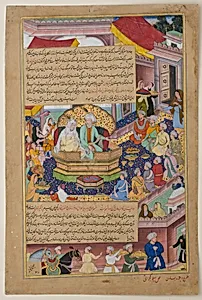
"Tumanba Khan, His Wife, and His Nine Sons", Folio from a Chingiznama (Book of Genghis Khan)
ca. 1596
Medium
Ink, opaque watercolor, and gold on paper
Dimensions
H. 15 in. (38.1 cm) W. 10 in. (25.4 cm)
Classification
Codices
Department
Islamic Art
Museum
Metropolitan Museum of Art, New York, NY
Credit
Purchase, Francis M. Weld Gift, 1948
Accession Number
48.144
Rights
Public Domain
Tags
Art Historical Context
Welcome to the Metropolitan Museum of Art's Islamic Art collection, where this exquisite folio from the *Chingnama* (Book of Genghis Khan captivates with its portrayal of Tumanba Khan his wife, and their nine sons. Created around 1596 by the Mughal painters Basawan andim Gujarati, it hails from the imperial workshops of Emperor Akbar, reflecting the court's deep interest in the history of Genghis Khan and Mongol rulers. These illustrated manuscripts blended Persian literary traditions with Indian artistry, immortalizing epic tales of conquest and lineage. Crafted in ink, opaque watercolor, and gold on paper (measuring 15 x 10 inches), the folio showcases the meticulous techniques of Mughal miniatures: fine-line drawing for dynamic figures, vibrant pigments for rich textures, and gold for luminous highlights. Horses, men, and women populate the scene, evoking themes of power, family, and nomadic grandeur central to Genghis Khan's legacy. This artwork underscores the cultural synthesis of the Mughal era, where historical chronicles became vehicles for artistic innovation, bridging Islamic, Persian, and Central Asian influences. A true gem for admirers of manuscript illumination!