
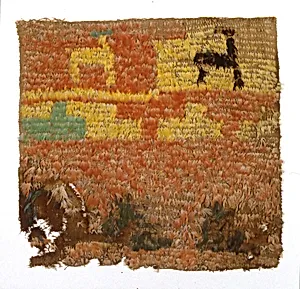
Tunic Fragment
1250-1532
Medium
Cotton, predominant warp plain weave with paired wefts; applied feathers
Dimensions
78.7 × 81.3 cm (31 × 32 in.)
Classification
textile
Department
Textiles
Museum
Art Institute of Chicago
Accession Number
103935
Rights
Public Domain
Art Historical Context
This exquisite **Tunic Fragment** hails from the Chimú culture of Peru's northern coast, thriving between 1250 and 1532 CE during the Late Intermediate Period. Crafted from cotton using a predominant warp plain weave with paired wefts, it features meticulously applied feathers—a hallmark of Chimú textile artistry. Measuring 78.7 × 81.3 cm, this piece once formed part of a prestigious tunic, likely worn by elites in the vast urban center of Chan Chan, the Chimú capital. Chimú weavers were master innovators, blending weaving techniques with featherwork to create vibrant, lightweight garments that signified status and spiritual power. Feathers, sourced from tropical birds, were glued and sewn onto the cotton base, producing shimmering mosaics that caught the light during ceremonies or processions. This labor-intensive process underscores the culture's advanced craftsmanship, where textiles rivaled gold and silver in value. Today, housed in the Art Institute of Chicago's Textiles Department, this fragment offers a glimpse into Chimú society before Spanish conquest. It highlights their reverence for nature's palette and technical prowess, reminding us how pre-Columbian artists wove stories of power and beauty into everyday splendor. (198 words)
About the Artist
Chimú
The Chimú, a preeminent pre-Columbian culture of Peru's northern coast, flourished from approximately 900 to 1470 CE as the Kingdom of Chimor, emerging in the wake of the Moche civilization's decline and incorporating influences from the Sican, Wari, and Cajamarca cultures. Centered in the vast adobe metropolis of Chan Chan—the largest city in the Americas before the Inca, housing up to 60,000 peo...