
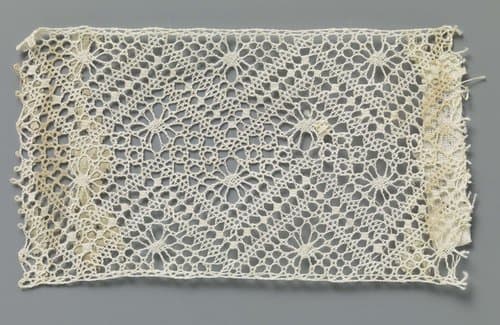
Tussenzetsel van kloskant met twee zigzag-banen
c. 1900
Medium
bobbin lace
Dimensions
2.6; 4.5; 8
Rights
Public Domain
About this artwork
De strook behoort tot een verzameling van achtentwintig stukken kant. De verzameling is bedoeld als studiemateriaal. De stukken zijn genummerd van BK-NM-14360-A t/m Z. Let op: bij -A en -C komen A-1, A-2, C-1 en C-2 voor.
Art Historical Context
This delicate bobbin lace insertion strip, titled *Tussenzetsel van kloskant met twee-banen*, showcases the intricate artistry of anonymous Flemish or Dutch lacemakers around 1900. Measuring just 8 cm long by 4.5 cm wide, it features two distinctive zigzag bands woven in fine threads, creating a rhythmic, geometric pattern ideal for embellishing garments orens. Bobbin lace, or *kloskant*, is a time-honored technique where threads are twisted and plaited using small bobbins and pins on a pillow, allowing for precise, complex designs that blend functionality with ornamentation. Created at the turn of the century, this piece reflects the enduring tradition of lace-making in Europe, particularly in regions like the Low Countries where it flourished from the Renaissance onward. By 1900, handmade lace persisted as a craft amid rising industrialization, valued for its tactile elegance and skill-intensive process—each zigzag band required meticulous counting and tension control to achieve symmetry. As part of a study collection of 28 numbered lace samples (BK-NM-14360-A through Z, with variants like A-1 and C-1), this artifact serves as educational treasure for museums and scholars. It preserves techniques for future generations, highlighting lace's cultural role in fashion, domestic arts, and heritage preservation. Visitors, imagine the patience behind these tiny threads!
About the Artist
anonymous
In the vast tapestry of art history, "Anonymous" stands not as a singular individual but as a collective designation for countless unidentified creators whose works have endured across millennia. These artists, spanning prehistoric cave painters to medieval illuminators and folk craftsmen, produced the foundational layers of human visual culture. Prior to the Renaissance, when individual fame emer...