
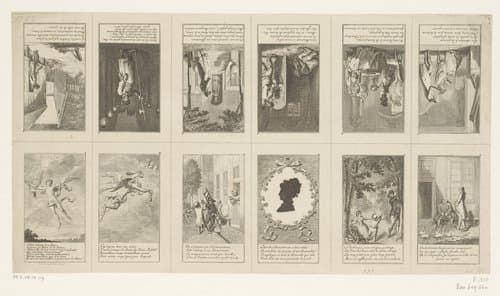
Twaalf verschillende scènes
Medium
etching
Dimensions
391; 211
Rights
Public Domain
About this artwork
ets; niet versneden blad
Art Historical Context
Daniel Nikolaus Chodowiecki, a prolific Polish-German artist and engraver of the late 18th century, created *Twaalf verschillende scènes* in 1779. This etching, measuring 211 mm high by 391 mm wide, presents an uncut sheet ("niet versneden blad") featuring twelve distinct vignettes—a testament to Chodowiecki's mastery in compact, narrative storytelling. Renowned for his illustrations of moral tales, literature, and everyday life, Chodowiecki bridged Rococo elegance with emerging Enlightenment realism, often capturing the social customs and fashions of Prussian society. Etching allowed Chodowiecki to achieve fine, expressive lines with remarkable detail on a single copper plate, enabling the reproduction of intricate multi-scene compositions at scale. This technique was revolutionary for disseminating affordable art to a broader audience, including the rising middle class. The uncut format preserves the sheet's original integrity, highlighting its status as a collector's piece from Berlin's vibrant print culture. Chodowiecki's work, including this piece, reflects the era's fascination with serialized vignettes that commented on human folly, virtue, and domestic scenes. As director of the Berlin Academy of Arts later in life, he influenced generations of printmakers, making *Twaalf verschillende scènes* a window into 18th-century Europe's cultural pulse.
About the Artist
Daniel Nikolaus Chodowiecki · 1726–1801
Daniel Nikolaus Chodowiecki (1726–1801) was a German painter and printmaker of Polish-Huguenot descent who became the most celebrated graphic artist in 18th-century Germany. Born in Danzig (now Gdańsk), he created approximately 2,000 etchings that serve as an invaluable visual record of German bourgeois life during the Enlightenment. Largely self-taught, Chodowiecki moved to Berlin in 1743 and ach...