
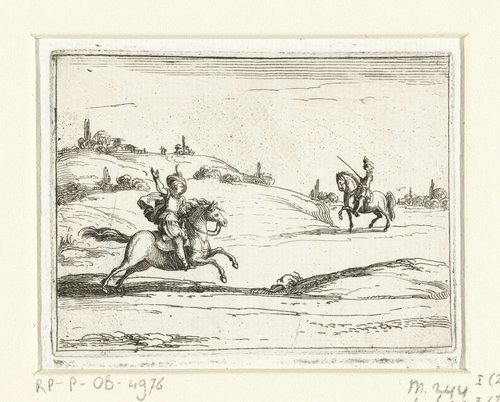
Twee ruiters
1621 - 1635
Medium
etching
Dimensions
81; 61
Rights
Public Domain
About this artwork
collector's mark: Lugt 240
Art Historical Context
**Twee Ruiters (Two Riders)** Jacques Callot, a masterful French etcher of the Baroque era (159–1635), created *Twee Ruiters* sometime between 1621 and1635. This intimate etching, measuring just 61 mm by 81 mm wide, captures two riders in a dynamic composition typical of Callot's keen eye for movement and detail. The work bears a collector's markLugt 240), hinting at its prized status among connoisseurs throughout history. Callot revolutionized etching techniques during a time of European upheaval, including the Thirty Years' War, which inspired many of his military and equestrian scenes. His innovative use of multiple acid bites allowed for extraordinarily fine lines and textures in such a tiny format, making his prints accessible yet richly detailed—almost like miniature paintings. This piece exemplifies his genre of small-scale equestrian studies, blending realism with dramatic flair. As a window into 17th-century life, *Twee Ruiters* showcases Callot's influence on printmaking, bridging art and reportage. Visitors will appreciate how this gem packs grand narratives into a pocket-sized frame, inviting closer inspection to uncover its subtle artistry.
About the Artist
Jacques Callot · 1592–1635
Jacques Callot (1592–1635) was a French printmaker and draftsman from the Duchy of Lorraine, widely regarded as one of the first great artists to practice the graphic arts exclusively. His more than 1,400 etchings chronicled the breadth of 17th-century life, from Medici court festivities to the brutal realities of warfare. Callot revolutionized etching through technical innovations including the é...