
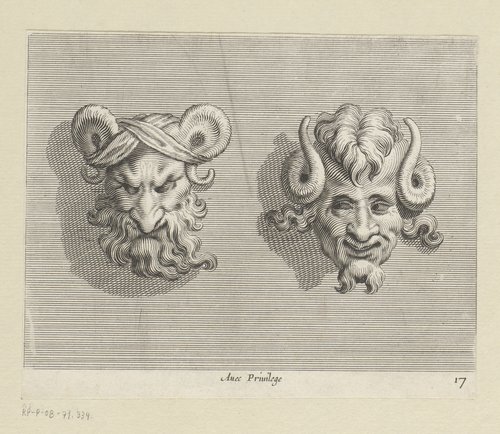
Twee satermaskers
1608 - 1688
Medium
engraving
Dimensions
131; 164
Rights
Public Domain
About this artwork
height 131 mm x width 164 mm
Art Historical Context
Claude Mellan's *Twee satermaskers* (Two Satyr Masks), exquisite engraving from the artist's prolific career spanning roughly 1608–1688, captures the playful yet grotesque essence of classical mythology. Mellan, a masterful French engraver of the Baroque era, was for his intricate line work and ability to convey texture and depth on a small scale. Measuring just 131 mm high by 164 mm wide, compact print exemplifies the portability and precision of 17th-century printmaking, allowing detailed imagery to be widely shared among collectors and scholars. Engraving, Mellan's chosen medium, involved incising fine lines into a copper plate with a burin, inking it, and pressing paper to create rich, tonal contrasts. This technique was revolutionary for its reproducibility, democratizing art beyond paintings and sculptures. Here, the satyr masks—leering, horned faces from Greek lore symbolizing revelry and the wild Dionysian spirit—showcase Mellan's skill in rendering dramatic expressions and ornate details, evoking the era's fascination with antiquity amid the Baroque's theatrical exuberance. These masks held cultural weight in Renaissance and Baroque art, often adorning architecture, theater, or fountains as emblems of fertility and mischief. Mellan's rendition invites viewers to ponder the blurred line between human and beast, a timeless motif that continues to intrigue in museum displays today.
About the Artist
Claude Mellan · 1598–1688
Claude Mellan (1598-1688) was a French draughtsman, engraver, and painter who became one of the most innovative printmakers of the French Baroque period. Born in Abbeville to a family of coppersmiths, Mellan rose to become Peintre et Graveur Ordinaire du Roi (Painter and Engraver in Ordinary to the King), achieving recognition for his extraordinary technical mastery. Mellan's artistic significanc...