
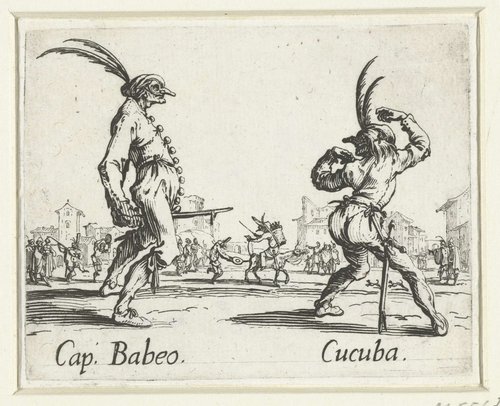
Twee straatartiesten als Capitano Babeo en Cucuba
1621 - 1622
Medium
etching
Dimensions
73; 92
Rights
Public Domain
About this artwork
plaatrand: hoogte 73 mm x breedte 92 mm
Art Historical Context
Jacques Callot's etching *Twee straatartiesten als Capitano Babeo Cucuba* (Two Street Artists as Capitanoo and Cucuba), between 1621 and1622, captures the spirit of itinerant performers in a remarkably compact format—just 73mm high by 92mm wide. As a leading French Baroque printmaker who spent much of his career Italy, Callot excelled at documenting the colorful world of street theater and commedia dell'arte the improvised Italian performances that captivated European audiences during the early 17th century. In this intricate scene, two street artists don the exaggerated costumes of Capitano Babeo—a boastful, sword-wielding captain archetype known for his bravado—and the playful Cucuba, evoking the masked, acrobatic antics of commedia troupes. Callot's works from this period, including series like *Balli di Sfessania*, immortalized these popular figures, blending satire with dynamic energy and reflecting the era's fascination with lowbrow entertainment amid courtly splendor. Masterfully executed in etching—a technique Callot refined with exceptionally fine lines and cross-hatching for depth and texture—this small print demonstrates his revolutionary precision, allowing mass reproduction of vivid, theatrical narratives. It offers visitors a window into the cultural vibrancy of 17th-century Europe, where high art met the hustle of the streets.
About the Artist
Jacques Callot · 1592–1635
Jacques Callot (1592–1635) was a French printmaker and draftsman from the Duchy of Lorraine, widely regarded as one of the first great artists to practice the graphic arts exclusively. His more than 1,400 etchings chronicled the breadth of 17th-century life, from Medici court festivities to the brutal realities of warfare. Callot revolutionized etching through technical innovations including the é...