
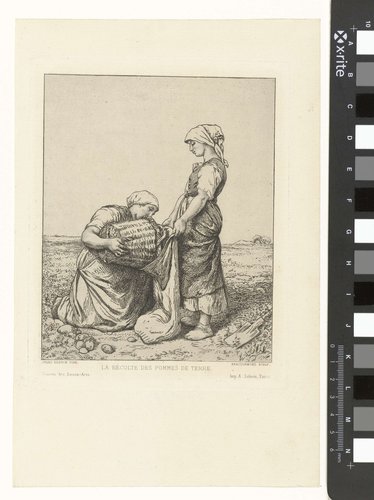
Twee vrouwen oogsten aardappelen op akker
Medium
etching
Dimensions
188; 149
Rights
Public Domain
About this artwork
ets
Art Historical Context
Félix Bracquemond's *Twee vrouwen oogsten aardappelen op akker* (Two Women Harvesting Potatoes in the Field), created in 1868, a humble moment of rural labor through the delicate medium of etching. Measuring 188 × 149 mm, this print depicts two women bent to their task amid a potato field, evoking the toil of 19th-century French peasants. Bracquemond, a pioneering French printmaker (1833–1914), was a key figure in the etching revival, bridging Realism's focus on ordinary life with emerging Impressionist sensibilities. Etching, Bracquemond's specialty, involves incising lines into a metal plate with acid, allowing for nuanced textures and tonal depth that mimic drawing's spontaneity. This technique elevated printmaking from reproduction to fine art, influencing contemporaries like Édouard Manet and Edgar Degas. Here, the etched lines likely convey the earth's texture and the figures' weary postures, highlighting social realities during France's post-Napoleonic agricultural era. Bracquemond's work underscores the era's fascination with pastoral scenes, blending technical virtuosity with subtle social commentary. A gem for etching enthusiasts, it invites visitors to appreciate how a small plate can immortalize fleeting labor.
About the Artist
Félix Bracquemond · 1833–1914
French, Paris 1833–1914 Sèvres