
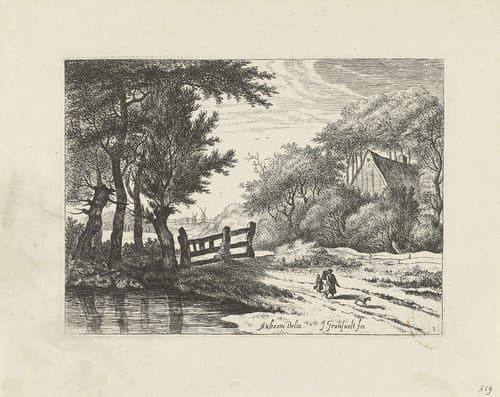
Twee wandelaars op landweg
1679 - 1728
Medium
etching
Dimensions
144; 198
Rights
Public Domain
About this artwork
opschrift, recto rechtsonder, geschreven: ‘519’
Art Historical Context
**Twee wandelaars opweg** (*Two Walkers on a Country Road*), an etching by Johannes Grons from around 1679–1728, captures a serene rural moment in a compact format (144 × 198 mm). This intimate print depicts two figures strolling along a quiet landweg, or country road, evoking the everyday tranquility of the Dutch countryside. Gronsveld, a lesser-known artist active during the tail end of the Dutch Golden Age, contributed to the tradition of landscape prints that celebrated the nation's flat, fertile landscapes and simple human activities. Etching, the medium here, was a favored technique in 17th- and early 18th-century Netherlands, allowing artists to incise fine lines into a metal plate with acid for rich, expressive detail. This method enabled widespread dissemination of images, bridging fine art and popular culture. The handwritten inscription "519" in the lower right recto likely served as an inventory mark, hinting at its place in a collector's album or institutional archive. Though modest in scale, the work reflects the enduring cultural value of pastoral scenes in Dutch art, symbolizing harmony with nature amid a prosperous era of trade and innovation. Visitors might appreciate its subtle invitation to ponder the quiet rhythms of rural life, preserved through Gronsveld's precise lines.
About the Artist
Johannes Gronsveld · 1650–1728
Johannes Gronsveld (also spelled Gronsvelt or Groensveld, active 1679–1728) was a Dutch engraver working in Amsterdam during the late seventeenth and early eighteenth centuries, specializing in reproductive engravings after works by prominent Dutch and Flemish painters. His career coincided with the post-Golden Age period of Dutch art, when the explosive creativity of the mid-seventeenth century h...