
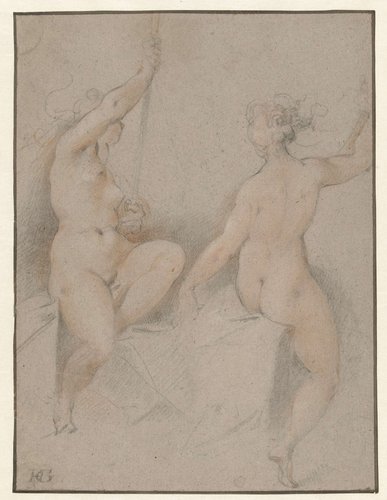
Twee zittende vrouwelijke naakten
Medium
cartridge paper
Dimensions
260; 195
Rights
Public Domain
About this artwork
…; collection Carel Vosmaer (1826-88), Montreux;{Note RMA.} his son, Prof. Dr Gualtherus Carel Jacob Vosmaer (1854-1916), Leiden; his son, C.J.J.G. Vosmaer (1907-86), Leiden; his heirs; from whom, fl. 650,000, with 212 other drawings, to the museum, with support from the Vereniging Rembrandt, the Rijksmuseum Stichting and The Ster, 1989
Art Historical Context
Hendrick Goltzius’s *Twee zittende vrouwelijke naakten* (Two Seated Female Nudes) is a delicate drawing executed on cartridge paper in 1568. Measuring 260 by 195 millimetres, the sheet captures the human form with the economical yet assured lines typical of a study sheet. Goltzius, who would become one of the most celebrated Dutch printmakers and draftsmen of the late sixteenth century, here explores anatomy and pose in a manner that already hints at the elegant elongation and graceful contours associated with Northern Mannerism. Drawings such as this were essential tools for artists of the period, serving both as private exercises in observation and as preparatory material for later paintings or engravings. The choice of cartridge paper—a sturdy, lightly textured support—allowed Goltzius to work fluidly with chalk or ink while preserving fine detail. Although created when the artist was still very young, the sheet demonstrates an early fascination with the nude that would recur throughout his career. The drawing’s documented provenance stretches from the distinguished Dutch collector Carel Vosmaer in the nineteenth century through successive generations of his family before entering the Rijksmuseum in 1989 with support from the Vereniging Rembrandt. Its presence in the national collection today offers visitors a rare glimpse of Goltzius’s formative explorations of the human figure.
About the Artist
Hendrick Goltzius · 1558–1617
Hendrick Goltzius (1558–1617) was the most celebrated engraver of the Northern Renaissance and a pivotal figure in Dutch Mannerism. Born near the German-Dutch border, Goltzius transformed printmaking into a virtuoso art form through his revolutionary 'swelling line' technique, where the burin was manipulated to create lines of varying thickness that produced unprecedented tonal effects and three-d...