
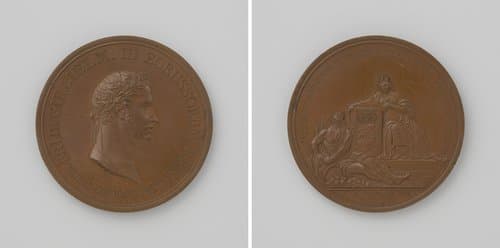
Tweede vrede van Parijs tussen Frankrijk en de geallieerden, ter ere van Frederik Willem III, koning van Pruisen
Medium
striking (metalworking)
Dimensions
261; 4.2
Rights
Public Domain
About this artwork
diameter 4,2 cm x gewicht 261 gr
Art Historical Context
Behold the *Tweede vrede van Pari tussen Frankrijk en de geieerden, ter ere Frederik Willem III, koning Pruisen* (Second Peace of Paris between France and the Allies, Honor of Frederick William III King of Prussia), a crafted medal struck by Daniel Friedrich Lo in 1815. just 4.2 cm in diameter and weighing a substantial 261 grams, this yet weighty piece—likely fashioned from a dense metal like silver or gold—serves as a tangible emblem of triumph following the Napoleonic Wars. The medal commemorates the Second Treaty of Paris, signed on November 20, 1815, which formally ended hostilities after Napoleon's defeat at Waterloo. Honoring Prussian King Frederick William III, a steadfast leader of the anti-French coalition alongside Britain, Austria, and Russia, it symbolizes the restoration of European monarchies and the redrawing of borders, with France ceding territories and paying reparations. Such medals were prized 19th-century artifacts, blending propaganda, patriotism, and artistry to immortalize pivotal moments. Loos, a skilled German medalist, employed the striking technique—pressing softened metal between engraved dies under immense pressure—to achieve sharp, intricate details on both obverse and reverse. This method allowed for mass production while preserving fine portraiture and allegorical motifs, making the medal not just a collectible but a pocket-sized history lesson for admirers of the era's neoclassical style. A delightful treasure for any visitor reflecting on the dawn of a new European order!
About the Artist
Daniel Friedrich Loos · 1735–1819
Daniel Friedrich Loos (1735–1819) was a German medallist, engraver, and die-cutter who served as chief engraver and medalist for the Kingdom of Prussia during a crucial period of Prussian history. Born on June 15, 1735, in Altenburg and dying on October 1, 1819, in Berlin, Loos pursued an 84-year life that spanned from the reign of Frederick William I through the Napoleonic Wars and into the post-...