
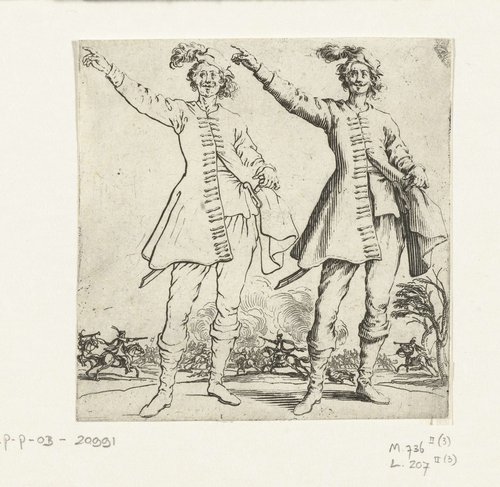
Tweemaal dezelfde soldaat met kleine gepluimde hoed en opgeheven arm, van voren gezien
1621 - 1624
Medium
etching
Dimensions
86; 85
Rights
Public Domain
About this artwork
verzamelaarsmerk, verso linksonder, gestempeld: Lugt 240
Art Historical Context
Jacques Callot's *Tweemaal dezelfde soldaat met kleine geplimde hoed enheven arm, van gezien* (Twice the Same Soldier with Small Plumed Hat and Raised Arm, Seen from the Front), created between 1621 and 1624, the artist's fascination with military figures during a turbulent era. As a leading French etcher of the Baroque period, Callot was renowned for his depictions of soldiers, often drawn from life amid the Thirty Years' War's early conflicts. This small etching (86 × 85 mm) showcases a single soldier rendered twice in the same frontal pose—plumed hat askew, arm raised—highlighting Callot's skill in repetition for study or compositional experimentation. Etching allowed Callot to achieve extraordinary detail with fine, wiry lines, revolutionizing printmaking by enabling mass reproduction of vivid scenes. This work likely belongs to his "Caprices of War" or similar series, blending realism with caricature to critique the dehumanizing effects of warfare. The verso bears a collector's mark (Lugt 240), underscoring its provenance and enduring appeal to connoisseurs. Visitors will appreciate how Callot transforms a modest format into a window on 17th-century Europe, where plumed hats symbolized fleeting martial glory amid chaos. A testament to his technical mastery, it invites closer inspection of every etched stroke.
About the Artist
Jacques Callot · 1592–1635
Jacques Callot (1592–1635) was a French printmaker and draftsman from the Duchy of Lorraine, widely regarded as one of the first great artists to practice the graphic arts exclusively. His more than 1,400 etchings chronicled the breadth of 17th-century life, from Medici court festivities to the brutal realities of warfare. Callot revolutionized etching through technical innovations including the é...