
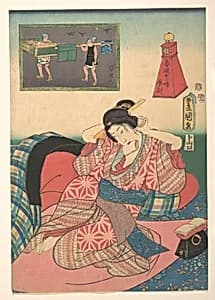
Twelve Hours of Spring Pleasures: Hour of the Dragon
19th century
Medium
Woodblock print; ink and color on paper
Dimensions
Image: 14 x 9 3/4 in. (35.6 x 24.8 cm)
Classification
Prints
Culture & Period
Japan · Edo period (1615–1868)
Department
Asian Art
Museum
Metropolitan Museum of Art, New York, NY
Credit
Bequest of William S. Lieberman, 2005
Accession Number
2007.49.269
Rights
Public Domain
Tags
Art Historical Context
Welcome to the Metropolitan Museum of Art's Asian Art collection, where we encounter *Twelve Hours of Spring Pleasures Hour of the Dragon*, captivating woodblock print by Utagawa Kunis (1786–1864), one of the most prolific masters of Japan's ukiyo-e tradition during the Edo period (1615–1868). This 19th-century work is part of a series exploring intimate moments across the twelve traditional two-hour segments of the day—here, the "Hour of Dragon" (roughly 7–9 a.m.). Kunisada, also known as Toyokuni III, excelled in depicting the "floating world" of urban pleasures, blending beauty, theater, and sensuality in vibrant scenes featuring men and women. Crafted as a nishiki-e ("brocade print") with ink and color on paper, the artwork showcases the collaborative genius of ukiyo-e production: artists designed, carvers shaped wooden blocks, and printers applied pigments for stunning multi-color effects, including subtle gradients (bokashi) that add depth and realism. Measuring 14 x 9¾ inches, its intimate scale suited private viewing, reflecting Edo Japan's thriving merchant culture where such prints were treasured collectibles. Culturally, this piece embodies shunga—erotic art that celebrated human connection amid societal constraints, often shared discreetly among friends. Kunisada's bold compositions and expressive figures highlight the period's playful eroticism, offering a window into Japan's sophisticated visual storytelling. A bequest from William S. Lieberman in 2005, it invites us to appreciate the artistry behind everyday desires.
About the Artist
Utagawa Kunisada · 1786–1864
**Utagawa Kunisada (1786–1865)** Born in 1786 in the Honjo district of Edo (modern Tokyo), Utagawa Kunisada hailed from a family with a hereditary ferry-boat service that provided financial stability, allowing him to pursue art from a young age. His father, an amateur poet of note, died shortly after his birth, leaving young Sumida Shōgorō (Kunisada's childhood name) to nurture his evident talent...