
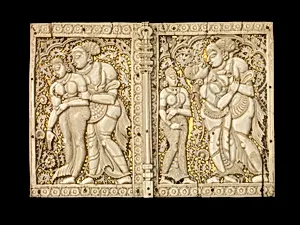
Two box panels with mithuna couples
Unknown Artist
late 17th–early 18th century
Medium
Ivory backed with gilded paper
Dimensions
5 11/16 × 8 in. (14.4 × 20.3 cm)
Classification
Sculpture
Culture
India (Tamil Nadu)
Department
Asian Art
Museum
Metropolitan Museum of Art, New York, NY
Credit
Purchase, Friends of Asian Art Gifts, 2013
Accession Number
2013.981a, b
Rights
Public Domain
Tags
Art Historical Context
These two ivory panels from late 17th- to early 18th-century Tamil Nadu depict mithuna couples—amorous male and female figures that symbolize love, fertility, and the harmonious union of opposites in Indian artistic traditions. Carved from delicate ivory and backed with gilded paper, the small sculptures (just over five by eight inches) were likely once part of a luxurious box or container. Their intimate scale and refined detail suggest they were created for a wealthy household, where such objects blended utility with aesthetic pleasure. In South Indian culture of this period, mithuna imagery drew from long-standing Hindu and regional traditions, celebrating human relationships as reflections of divine balance. The unknown artist’s choice of ivory highlights the material’s prestige in Tamil Nadu, where its smooth surface allowed for intricate carving that captured flowing garments, expressive gestures, and tender interactions between the figures. The gilded backing would have added a subtle shimmer, enhancing the panels’ elegance when viewed in lamplight. Today, these works offer visitors a glimpse into the refined domestic arts of southern India, where sculpture extended beyond temple walls into everyday luxury items. Their presence in the Metropolitan Museum’s collection underscores the enduring appeal of these tender, symbolic scenes across centuries.