
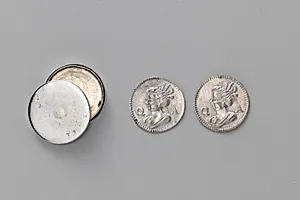
Two card counters in box with cover
Unknown Artist
1702–14
Medium
Silver
Dimensions
Diameter: 3/4 in. (1.9 cm)
Classification
Metalwork-Silver
Culture
British
Department
European Sculpture and Decorative Arts
Museum
Metropolitan Museum of Art, New York, NY
Credit
Anonymous Gift, 1913
Accession Number
13.15a–d
Rights
Public Domain
Tags
Art Historical Context
Nestled in the Metropolitan Museum of Art's European Sculpture and Decorative Arts collection, *Two Card Counters in Box with* is a delicate silver treasure from early 18th-century Britain crafted between 1702 and 1714. Measuring just 3/4 inch in diameter, this diminutive metalwork object exemplifies the exquisite miniaturization of the Queen Anne era, when silver artisans produced finely wrought items for the genteel pursuits of the upper classes. Housed in a lidded box, the two counters were likely used to track scores in fashionable card games like ombre or piquet, reflecting the era's booming social gambling culture among aristocracy and gentry. The object's artistic significance lies in its intricate silver craftsmanship, a hallmark of British metalwork during the transition to the Georgian period. Silversmiths employed techniques such as chasing and engraving to create detailed profiles of women—evident from the tags highlighting female motifs—which added a layer of elegance and personalization. These subtle portraits evoke the period's fascination with classical-inspired silhouettes, blending utility with ornamental beauty. Though the artist remains unknown, this anonymous gift of 1913 preserves a snapshot of refined leisure. Imagine slipping it into a pocket for an evening of whist: a tiny emblem of 1700s sophistication, where even game accessories doubled as wearable art.