
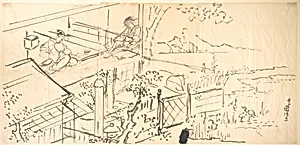
Two Courtesans Enjoying the View from a Teahouse
Medium
Ink on thin paper
Dimensions
14 1/4 x 30 1/2 in. (36.2 x 77.5 cm)
Classification
Prints
Culture & Period
Japan · Edo period (1615–1868)
Department
Asian Art
Museum
Metropolitan Museum of Art, New York, NY
Credit
Fletcher Fund, 1939
Accession Number
JP2754
Rights
Public Domain
Tags
Art Historical Context
In the vibrant world of Edo-period Japan (1615–1868), Utagawa Kunada (also known asiransai Kunits), a master of ukiyo-e—"pictures of the floating world"—ured the fleeting pleasures of urban life. This enchanting print, *Two Courtesans Enjoy the View from a Teouse*, showcases two elegant courtesans relaxing in a teahouse, gazing at a scenic vista dotted with houses and trees. Kunisada's bijin-ga (beautiful women) style highlights their graceful kimonos and poised demeanor, evoking the glamorous Yoshiwara pleasure district where high-class entertainers held sway. Rendered in ink on thin paper—a hallmark of Japanese woodblock printing—this horizontal composition (14¼ × 30½ in.) masterfully exploits the medium's fluidity to suggest depth and atmosphere. The expansive format, known as ōban nishiki-e in broader ukiyo-e tradition, draws viewers into the intimate yet panoramic moment, blending architecture, nature, and femininity with delicate linework and subtle shading. Acquired through the Fletcher Fund in 1939 for the Metropolitan Museum of Art's Asian Art collection, this work exemplifies Edo Japan's celebration of leisure and beauty amid social constraints. It invites us to savor the artistry of a bygone era, where everyday indulgence became timeless poetry.
About the Artist
Utagawa Kunisada|Ichiransai Kunitsuna · 1786–1864
**Utagawa Kunisada (1786–1865)** Born in 1786 in the Honjo district of Edo (modern Tokyo), Utagawa Kunisada hailed from a family with a hereditary ferry-boat service that provided financial stability, allowing him to pursue art from a young age. His father, an amateur poet of note, died shortly after his birth, leaving young Sumida Shōgorō (Kunisada's childhood name) to nurture his evident talent...