
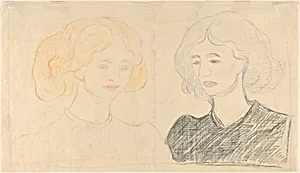
Two Female Heads Against a Reflection of the Moon
1899
Medium
color crayons on transfer paper
Dimensions
overall: 28.6 x 49.8 cm (11 1/4 x 19 5/8 in.)
Classification
Drawing
Department
CG-E
Museum
National Gallery of Art, Washington, D.C.
Credit
The Epstein Family Collection
Accession Number
2000.42.1
Rights
Public Domain
Art Historical Context
Edvard Munch's *Two Female Heads Against a Reflection of the Moon* (1899) captures the Norwegian artist's signature Expressionist intensity through an intimate drawing on transfer paper using vibrant color crayons. Measuring 28.6 x 49.8 cm, this work from The Epstein Family Collection at the National Gallery of Art evokes Munch's lifelong fascination with human emotion, love, and the sublime forces of nature. Created during his prolific Berlin period, it reflects the Symbolist influences that shaped his shift from Naturalism toward raw psychological expression, much like his iconic *The Scream* from the same decade. The ethereal composition juxtaposes two contemplative female profiles against the moon's shimmering reflection, blending tenderness with an undercurrent of melancholy. Munch often drew women as muses and mirrors of inner turmoil, drawing from personal experiences of loss and desire. The use of transfer paper—a technique he employed for printmaking experiments—highlights his innovative approach to color and texture, allowing bold, gestural strokes that convey mood over precise realism. This drawing exemplifies Munch's bridge between painting and print, influencing modern graphic arts and remaining a poignant testament to fin-de-siècle anxieties. Visitors will appreciate its dreamlike glow, inviting reflection on the eternal dance between humanity and the cosmos.
About the Artist
Edvard Munch · 1863–1944
Edvard Munch (1863-1944) was a Norwegian painter and printmaker whose intensely psychological works made him a pioneer of Expressionism and one of the most influential artists of the modern era. His 1893 masterpiece 'The Scream' has become an iconic symbol of existential anxiety. Munch's art was profoundly shaped by personal tragedy—his mother died when he was five, his beloved sister Sophie at fo...