
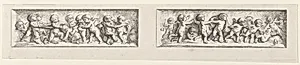
Two Friezes with Playing Putti, from: L'Oeuvre de J. B. Huet (Premier Livre, Sixieme Cahier, pl. 34)
1780 or after
Medium
Etching
Dimensions
sheet: 2 1/2 x 13 9/16 in. (6.3 x 34.4 cm)
Classification
Prints
Department
Drawings and Prints
Museum
Metropolitan Museum of Art, New York, NY
Credit
Bequest of Phyllis Massar, 2011
Accession Number
2012.136.154
Rights
Public Domain
Tags
Art Historical Context
In the enchanting etching *Two Friezes with Playing Putti* (plate 34 from *L'Oeuvre de J. B. Huet*, Livre, Sixième Cah), Jean-Baptiste Huet captures the whimsical spirit of late 18th-century decorative art. Created around 1780 or later, this print features two horizontal friezes with frolicking putti—those plump, playful cherubic figures borrowed from classical antiquity. Huet, a master of the Rococo style with its love of elegance and lighthearted fantasy, renders these infants in dynamic poses, evoking the joy of pastoral idylls and ornate interior decorations popular among the French aristocracy on the eve of the Revolution. As an etching, the work showcases Huet's skill in printmaking, where acid etches intricate lines into a metal plate for reproduction, allowing widespread dissemination of his designs for wallpapers, textiles, or furniture. Measuring just 2½ x 13⅝ inches, its compact format belies its decorative ambition, ideal for framing as panels or inspiring artisans. Donated to the Metropolitan Museum of Art through the bequest of Phyllis Massar in 2011, this piece from the Drawings and Prints department highlights Huet's versatility beyond painting, blending Rococo charm with emerging Neoclassical poise. Putti like these symbolized innocence and divine play, a motif that bridged Baroque exuberance and the refined tastes of Louis XVI-era France. Visitors will delight in Huet's fluid lines and lively compositions, a window into an era when art brought levity to lavish living.