
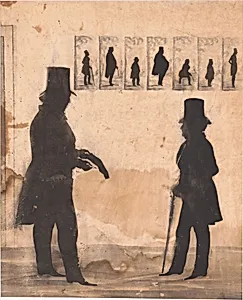
Two Men, One Cutting a Silhouette
1830–1900
Medium
Cut paper and ink wash
Dimensions
sheet: 15 13/16 x 13 1/16 in. (40.2 x 33.2 cm)
Classification
Cut Paper
Department
Drawings and Prints
Museum
Metropolitan Museum of Art, New York, NY
Credit
The Glenn Tilley Morse Collection, Bequest of Glenn Tilley Morse, 1950
Accession Number
50.602.143
Rights
Public Domain
Tags
Art Historical Context
In the 19th-century United States, silhouette cutting emerged as a beloved form of folk portraiture, offering affordable and swift likenesses long before photography dominated. This charming anonymous work, *Two Men, One Cutting Silhouette* (1830–1900), that very tradition in action: one man deftly wields scissors to craft a profile from black paper while his companion watches intently. Created with cut paper and subtle ink wash on a modest sheet measuring about 16 x 13 inches, it exemplifies the precision and whimsy of this ephemeral art form, now preserved in the Metropolitan Museum of Art's Drawings and Prints department from the Glenn Tilley Morse Collection. Silhouettes like this were often produced by itinerant artists at fairs, parties, or homes, turning a few minutes of shadow-play into treasured mementos. The ink wash adds depth and narrative flair, elevating a simple scene into a meta-commentary on creativity itself. As a snapshot of everyday American life, it highlights the democratizing power of folk art—accessible to all classes during a time of rapid social change. Visitors to the Met will appreciate this piece's playful nod to artistry in motion, a testament to the ingenuity of unnamed makers who captured the human spirit with just paper and blade.