
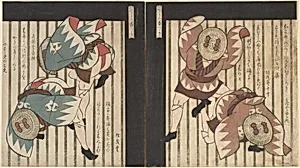
Two Men Wearing Brown Coats, also Straw Hats with Brown Bows
Medium
Woodblock print (surimono); ink and color on paper
Dimensions
7 7/16 x 7 3/16 in. (18.9 x 18.3 cm)
Classification
Prints
Culture & Period
Japan · Edo period (1615–1868)
Department
Asian Art
Museum
Metropolitan Museum of Art, New York, NY
Credit
Seymour Fund, 1981
Accession Number
JP3607
Rights
Public Domain
Tags
Art Historical Context
Discover the charming woodblock print *Two Men Wearing Brown Coats also Straw Hats with Brownows* by Yashima Gakutei, a master of late Edo-period (1615–1868) Japanese art. Created as a *surimono*—a privately commissioned print often produced for special occasions like New Year's or poetry gatherings—this intimate work measures just 7 7/ x 7 3/16 inches, perfect for personal appreciation. Gakutei's precise lines and vibrant inks on paper capture two men in everyday attire, their brown coats and straw hats adorned with bows evoking the fashionable "floating world" (*ukiyo*) of urban Edo life. Surimono like this one elevated woodblock printing beyond mass-produced *ukiyo-e*, featuring luxurious techniques such as subtle embossing, mica dusting, and calligraphy (though specifics here are unrecorded). Gakutei, active around the 1820s–1830s, blended realism with poetic elegance, making his prints prized collector's items. This piece offers a glimpse into Edo Japan's social scene, where such depictions of ordinary men highlighted cultural values of harmony and transience. Housed in the Metropolitan Museum of Art's Asian Art Department (Seymour Fund, 1981), it exemplifies the refined artistry that bridged traditional woodblock methods with personal expression, inviting us to ponder the lives behind these stylish figures.
About the Artist
Yashima Gakutei · 1786–1868
Yashima Gakutei (c. 1786–1868), born in Osaka as the illegitimate son of a Tokugawa shogunate samurai named Hirata, adopted the name from his mother's subsequent marriage into the Yashima clan. Little is documented about his early years beyond these familial ties, but he pursued artistic training under the esteemed ukiyo-e masters Totoya Hokkei and Katsushika Hokusai, absorbing their precision in ...