
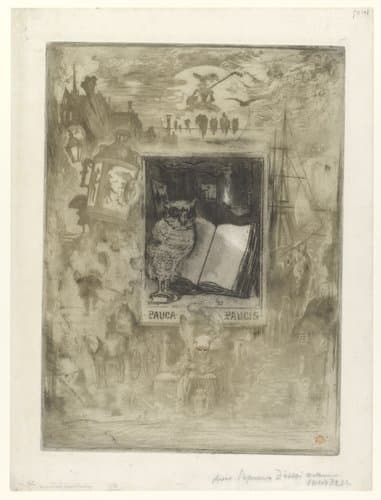
Uil bij een opengeslagen boek, omringd door illustraties in de marge
c. 1883
Medium
etching
Dimensions
445; 326
Rights
Public Domain
About this artwork
Karakteristiek voor Buhot zijn de illustraties die hij in de marges van zijn prenten plaatste, zoals ook bij deze prent het geval is. De inventie die hij "marges symphoniques" noemde, versterkte het hoofdonderwerp van de prent en maakte er integraal deel van uit. Buhot werd geïnspireerd door decoraties in de marges van Middeleeuwse manuscripten en achttiende-eeuwse Franse boekillustraties. De prent zou een titelprent vormen voor een serie met verscheidene werken uit het oeuvre van de kunstenaar....
Art Historical Context
Félix Hilaire Buh's etching *Uil bij een opengeslagen, omringd dooraties in de marge*Owl Beside an Open Book, Sur by Marginal Illustrations), created around 1883, measures an impressive 445mm by 326mm. This 19th-century French print captures Buhot's ingenuity, with a wise owl perched near an open book at the center, enveloped by lively marginal vignettes. As a master etcher, Buhot elevated printmaking beyond mere reproduction, infusing his works with narrative depth and whimsy. What truly distinguishes this piece are Buhot's "marges symphoniques"—symphonic margins—that he invented. These intricate border decorations, integral to the composition, amplify the central motif and draw inspiration from the ornate margins of medieval manuscripts and 18th-century French book illustrations. They create a rhythmic, immersive experience, blending symbolism (the owl evoking wisdom and scholarship) with decorative exuberance. Intended as the title plate for a proposed series showcasing Buhot's diverse oeuvre, the project never materialized, and the printing plate was lost. Today, surviving impressions offer a rare glimpse into Buhot's unfulfilled ambitions, highlighting his role in pushing etching toward painterly, multifaceted storytelling during a transformative era in French art.