
Un Abri (A Shelter)
1858
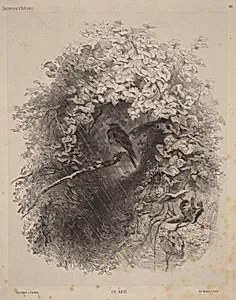
Medium
lithograph in black on chine collé
Dimensions
sheet: 25.1 x 20 cm (9 7/8 x 7 7/8 in.) support: 43.5 x 29.9 cm (17 1/8 x 11 3/4 in.)
Classification
Department
CG-E
Museum
National Gallery of Art, Washington, D.C.
Credit
René Huyghe Collection
Accession Number
1994.42.1
Rights
Public Domain
Art Historical Context
Karl Bodmer’s 1858 lithograph “Un Abri (A Shelter)” captures a quiet moment of refuge rendered with remarkable delicacy. Created well after the Swiss-born artist’s celebrated travels in North America, the print reflects his mature European period, when he turned his observant eye toward intimate landscapes and architectural subjects. The title suggests a simple structure offering protection, rendered in fine tonal gradations that invite viewers to linger on texture and atmosphere. Printed in black on chine collé—a technique in which a thin sheet of Chinese paper is mounted onto a heavier support during printing—the work demonstrates the medium’s ability to convey both crisp line work and soft, velvety tones. This method allowed Bodmer to achieve subtle effects of light and shadow, giving the shelter a tangible sense of place and stillness. Housed in the National Gallery of Art as part of the René Huyghe Collection, the lithograph exemplifies the 19th-century printmaker’s skill in transforming everyday scenes into enduring visual poetry, bridging documentary observation with poetic sensibility.
About the Artist
Karl Bodmer · 1809–1893
Johann Carl Bodmer was born on February 11, 1809, in Zürich, Switzerland, and received his training as a painter and engraver under his uncle Johann Jakob Meier, who had himself studied under the prominent engraver Heinrich Füssli. By the late 1820s Bodmer had relocated to Koblenz, Germany, where his work came to the attention of Prince Maximilian zu Wied-Neuwied, a German naturalist-explorer plan...