
Unidentified building, ceiling or wall, painted frieze or decorative panels (recto) Unidentified building, cornice (verso)
early to mid-16th century
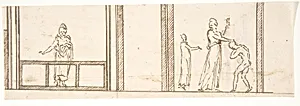
Medium
Dark brown ink, black chalk, and incised lines
Dimensions
sheet: 3 1/8 x 9 9/16 in. (8 x 24.3 cm)
Classification
Drawings|Ornament & Architecture
Department
Drawings and Prints
Museum
Metropolitan Museum of Art, New York, NY
Credit
Purchase, Rogers Fund, Joseph Pulitzer Bequest, and Mark J. Millard Gift, 1968
Accession Number
68.769.55
Rights
Public Domain
Tags
Art Historical Context
This delicate drawing captures the ornate architectural details of an unidentified French building from the early to mid-16th century, a painted frieze or decorative panels on the recto (front) and a cornice on the verso (back). Rendered in dark brown ink, black, and incised lines a modest sheet measuring just 3 1/8 x 9 9/16 inches, it hints at the grandeur of Renaissance-era interiors. The inclusion of female figures, as noted in the tags, suggests classical motifs—perhaps graceful women in mythological or allegorical poses—adorning walls or ceilings, a hallmark of the period's fascination with antiquity. Created anonymously by a French artist during the Renaissance, this work exemplifies the meticulous preparatory sketches used by architects and decorators. The incised lines, scored into the paper, indicate it served as a pattern for transfer, likely guiding artisans in carving stucco, painting frescoes, or crafting moldings. Such drawings were vital in disseminating innovative ornamental designs inspired by Italian models, blending Gothic traditions with emerging Renaissance humanism. Housed in the Metropolitan Museum of Art's Drawings and Prints department, this piece offers a window into 16th-century French taste for elaborate, narrative decoration. Though the building remains unknown, its survival underscores the era's technical ingenuity and cultural reverence for harmonious, figure-filled spaces that elevated everyday architecture into art.