
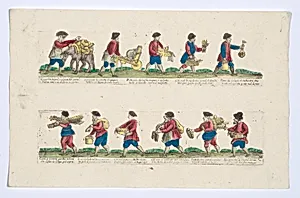
Unnumbered plate depicting the trades of Rome, here including vendors of kitchen pots, garden stakes, cups etc, from the 'Descrición de las artes que se llaman para los calles de la ciudad de Roma'
ca. 1770–1800
Medium
Engraving with hand coloring
Dimensions
Sheet: 9 1/2 × 15 3/16 in. (24.2 × 38.5 cm) Plate (Top): 2 7/8 × 12 3/16 in. (7.3 × 31 cm) Plate: 2 13/16 × 12 3/16 in. (7.2 × 31 cm)
Classification
Prints
Department
Drawings and Prints
Museum
Metropolitan Museum of Art, New York, NY
Credit
Purchase, Ann and Matthew Nimetz Gift, 2022
Accession Number
2022.85
Rights
Public Domain
Art Historical Context
This vibrant engraving captures the bustling street trades of 18th-century Rome, vendors hawking everyday essentials like kitchen pots, stakes, and cups.itled an unnumbered plate from theDescrición de las que se llaman para los de la ciudad de Roma—a descriptive series on Rome's urban commerce—it offers a lively snapshot of the city's vibrant markets. Produced around 1770–1800 by engraver Giovanni Ambrogio Brambilla and associated with the Remondini firm, it reflects the era's fascination with Roman daily life during the Grand Tour period, when travelers documented the Eternal City's colorful underbelly. The medium of engraving with hand coloring is key to its appeal: fine lines etched into a metal plate allowed precise details of merchants, wares, and cobblestone scenes, while artisanal hand-applied colors brought warmth and realism to the black-and-white print. Measuring about 9½ × 15 inches on the sheet, this intimate scale made it ideal for collectors' albums, preserving ephemeral street scenes for posterity. Today, housed in the Metropolitan Museum of Art's Drawings and Prints department (acquired in 2022 via the Ann and Matthew Nimetz Gift), it invites us to ponder Rome's enduring rhythm of trade—timeless haggling amid ancient shadows. A delightful window into pre-industrial urban vitality!