
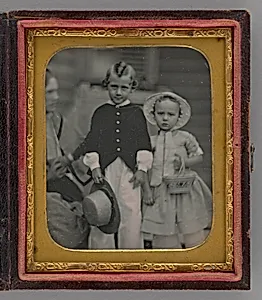
Untitled (Portrait of a Boy and Girl)
1855
Medium
Daguerreotype
Dimensions
8 × 7 cm (3 3/16 × 2 13/16 in.); Open case: 9.3 × 16 × 1 cm (3 11/16 × 6 5/16 × 7/16 in.); Case: 9.3 × 8 × 1.4 cm (3 11/16 × 3 3/16 × 9/16 in.); Plate: 8.3 × 7 cm (3 1/4 × 2 3/4 in.)
Classification
portrait
Department
Photography and Media
Museum
Art Institute of Chicago
Accession Number
250028
Rights
Public Domain
Art Historical Context
**Untitled (Portrait of a and Girl), 1855** This intimate daguerreotype captures a boy and girl, likely siblings, gazing solemnly at the viewer from within a protective case. Created by an unknown maker in 1855, the tiny 8 × 7 cm image exemplifies early photography's delicate beauty. Housed in a locket-like case—measuring just 9.3 × 8 × 1.4 cm when closed—it was designed for personal cherishing, much like a family heirloom. Daguerreotypes, the first practical photographic process introduced in 1839, produced one-of-a-kind positive images on silvered copper plates through a mercury vapor development technique. By the mid-1850s, they were prized for their mirror-like detail and clarity, especially in portraits that democratized portraiture for the growing middle class. No negatives meant each was unique, making this portrait irreplaceable. The long exposure times—often minutes—required subjects to sit perfectly still, lending the children an ethereal, almost timeless poise. Held in the Art Institute of Chicago's Photography and Media department, this work highlights photography's swift evolution from novelty to cultural staple, preserving fleeting moments of 19th-century life with astonishing precision. A window into Victorian family values, it invites us to ponder the anonymous sitters' stories.