
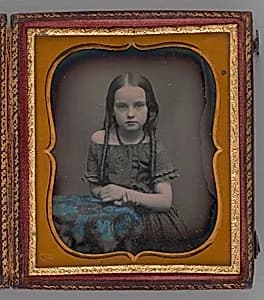
Untitled (Portrait of a Girl)
1855
Medium
Daguerreotype
Dimensions
8.2 × 7 cm (3 1/4 × 2 13/16 in.); Open case: 9.2 × 16 × 1 cm (3 5/8 × 6 5/16 × 7/16 in.); Case: 9.2 × 8 × 1.5 cm (3 5/8 × 3 3/16 × 5/8 in.); Plate: 8.3 × 7 cm (3 1/4 × 2 3/4 in.)
Classification
portrait
Department
Photography and Media
Museum
Art Institute of Chicago
Accession Number
250037
Rights
Public Domain
Art Historical Context
This delicate *Untitled (Portrait of a Girl, created in 1855 by an unknown maker, captures the innocence of youth through the lens of early photography. Measuring just 8.2 × 7 cm, the daguerreotype—a one-of-a-kind positive image on a silvered copper plate—presents a mirror-like reflection of its young subject, likely seated or posed with quiet poise. Housed in a protective case that opens to 9.2 × 16 × 1 cm, it evokes the era's tradition of treating photographs like precious jewels, often carried in pockets or displayed on parlour tables. As one of the first viable photographic processes, invented by Louis Daguerre in 1839, the daguerreotype revolutionized portraiture by 1855. No longer reserved for the elite who could afford painted miniatures, these tiny, detailed images made personal likenesses accessible to the growing middle class. The medium's exposure times, though shortened by then to mere seconds, demanded stillness, lending portraits an intimate, almost ethereal quality. Held in the Art Institute of Chicago's Photography and Media Department, this work exemplifies mid-19th-century innovation, bridging art and science while preserving a fleeting moment from everyday life.