
Untitled (Portrait of a Woman Reading)
1845
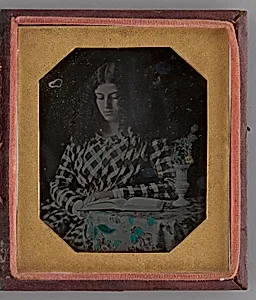
Medium
Daguerreotype
Dimensions
8.2 × 7.1 cm (3 1/4 × 2 13/16 in.); Open case: 9.2 × 16.3 × 1.1 cm (3 5/8 × 6 7/16 × 7/16 in.); Case: 9.2 × 8.3 × 1.5 cm (3 5/8 × 3 5/16 × 5/8 in.); Plate: 8.3 × 7 cm (3 1/4 × 2 3/4 in.)
Classification
portrait
Department
Photography and Media
Museum
Art Institute of Chicago
Accession Number
249908
Rights
Public Domain
Art Historical Context
Step into the intimate world of early photography with *Untitled (Portrait of a Woman Reading)*, a daguerreotype created in 1845 by an unknown maker. This tiny portrait, measuring just 8.2 × 7.1 cm on its plate, captures a serene moment of a woman absorbed in her book, housed in a protective case typical of the era. Displayed in the Art Institute of Chicago's Photography and Media department, it exemplifies the delicate precision of daguerreotypes—the first publicly available photographic process, invented by Louis Daguerre in 1839. Daguerreotypes like this one were made on silvered copper plates treated with chemicals and exposed in a camera for several minutes, producing a unique, mirror-like positive image that couldn't be duplicated. In 1845, just six years after its debut, this medium revolutionized portraiture, making lifelike likenesses affordable for the middle class despite their fragility and small scale. The subject's quiet reading pose reflects the era's growing emphasis on personal reflection amid the Industrial Revolution. This artwork holds cultural significance as a window into mid-19th-century domestic life, blending the tradition of painted portraits with photography's unprecedented realism. Its preservation highlights how these "mirrors with a memory," as Oliver Wendell Holmes called them, captured fleeting humanity in an age of rapid change.