
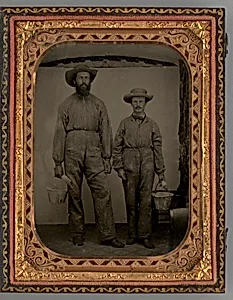
Untitled (Portrait of Two Standing Men)
1870
Medium
Ambrotype
Dimensions
10.8 × 8.1 cm (4 5/16 × 3 1/4 in.); Open case: 11.8 × 18.6 × 1.1 cm (4 11/16 × 7 3/8 × 7/16 in.); Case: 11.8 × 9.3 × 1.9 cm (4 11/16 × 3 11/16 × 3/4 in.); Plate: 10.8 × 8.3 cm (4 1/4 × 3 1/4 in.)
Classification
portrait
Department
Photography and Media
Museum
Art Institute of Chicago
Accession Number
250195
Rights
Public Domain
Art Historical Context
Step into the intimate world of 19th-century photography with *Untitled (Portrait of Two Standing Men)*, a poignant ambrotype from 1870 housed in the Art Institute of's Photography and Media department. Captured by an unknown maker, this small-scale portrait (measuring just 10.8 × 8.1 cm) depicts two men standing side by side, their formal poses and attire evoking the solemnity of the post-Civil War era.ased in a protective leather or thermoplastic holder—typical for such precious images—it was likely a cherished personal memento, small enough to carry close to the heart. Ambrotypes, popular from the 1850s to the early 1870s, represent a pivotal advancement in photographic technology. Created via the wet-plate collodion process, the image is a unique glass negative that appears positive when backed with black velvet or paint, producing rich tonal depth without the need for printing. Unlike mass-reproducible modern photos, each ambrotype is one-of-a-kind, demanding skilled handcrafting and viewing under specific light—highlighting photography's transition from daguerreotypes to more accessible portraiture. This unpretentious yet evocative piece underscores the democratizing power of mid-19th-century imaging, allowing everyday individuals to preserve their likenesses amid rapid social change. Its anonymity invites us to ponder the stories of these two men—friends, brothers, or comrades?—frozen in a moment of quiet dignity.