
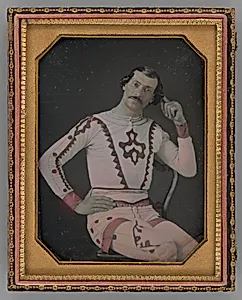
Untitled (Portrait of William G. Worrell of Welch’s National Circus)
1855
Medium
Daguerreotype
Dimensions
14 × 10.8 cm (5 9/16 × 4 5/16 in.); Open case: 15.1 × 24.2 × 1.1 cm (6 × 9 9/16 × 7/16 in.); Case: 15.1 × 12.1 × 1.9 cm (6 × 4 13/16 × 3/4 in.); Plate: 14 × 10.8 cm (5 1/2 × 4 1/4 in.)
Classification
portrait
Department
Photography and Media
Museum
Art Institute of Chicago
Accession Number
250161
Rights
Public Domain
Art Historical Context
Step into the spotlight of 1850s America with this captivating *Untitled (Portrait of William G. Worrell of Welch’s National Circus)*, a rare daguerreotype from 1855. Captured by an unknown maker, this intimate 14 × 10.8 cm portrait depicts Worrell, a performer with one of the era's premier traveling circuses, housed in its original protective case for safekeeping. Daguerreotypes like this were the pinnacle of early photography—a one-of-a-kind positive image etched onto a polished silver-plated copper sheet, gleaming with a mirror-like sheen when tilted just right. In the mid-19th century, daguerreotypy revolutionized portraiture, making lifelike likenesses accessible beyond the elite for the first time. By 1855, studios dotted U.S. cities, churning out these treasures as cherished mementos. Worrell's image offers a vivid glimpse into the vibrant world of American circuses, which dazzled audiences with acrobats, clowns, and exotic animals amid the young nation's growing fascination with spectacle and mobility. Held in the Art Institute of Chicago's Photography and Media department, this petite gem underscores photography's role in documenting everyday heroes of popular culture. Its technical precision and cultural snapshot remind us how a single plate could immortalize the thrill of the big top, bridging art and history in a single, shimmering frame.