
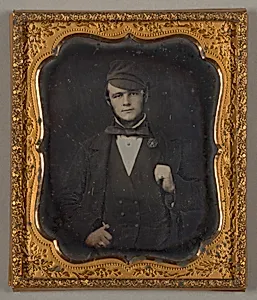
Untitled (Young Man Standing)
1839/60
Medium
Daguerreotype
Dimensions
Frame: 8.5 × 7.3 cm (3 3/8 × 2 7/8 in.)
Classification
photography
Department
Photography and Media
Museum
Art Institute of Chicago
Accession Number
218183
Rights
Public Domain
Art Historical Context
Step into the dawn of photography with *Untitled (Young Man Standing, a captivating daguerreotype from around 1839–1860, now housed in the Art Institute Chicago's Department of Photography and Media. This petite portrait, framed at just 8.5 × 7.3 cm, captures a young man in a poised, formal stance—typical of early photographic subjects who held still for minutes to avoid blurring. As one of the first viable photographic processes, invented by Louis Daguerre and publicly unveiled in 1839, the daguerreotype produced a single, mirror-like positive image on a polished silvered copper plate, treated with chemicals to fix the light-sensitive exposure. What makes this piece remarkable is its rarity and technical marvel. Unlike modern prints, each daguerreotype is utterly unique—no negatives meant no duplicates—making it a precious artifact of innovation. Created during photography's infancy, it reflects a cultural shift: portraits, once the privilege of painted elites, became accessible to the middle class, preserving everyday faces with unprecedented realism and detail. Today, this anonymous image invites us to ponder the young man's story—lost to time yet vividly alive through light and chemistry. It stands as a testament to how photography redefined art, bridging 19th-century portraiture with our image-saturated world.
About the Artist
Unknown
The artist designated as "Unknown" in our virtual museum's collection exemplifies a poignant chapter in art history: creators whose identities have faded into obscurity despite the enduring power of their work. With only one known artwork attributed to them in our holdings, this figure represents countless anonymous hands that shaped visual culture across centuries. Museums worldwide, including th...