
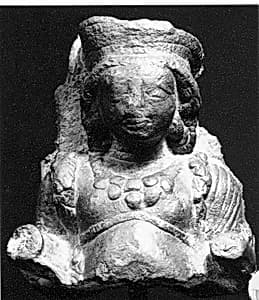
Upper Half of a Deity or King
Unknown Artist
5th century
Medium
Bronze
Dimensions
H. 4 1/16 in. (10.3 cm)
Classification
Sculpture
Culture
Afghanistan
Department
Asian Art
Museum
Metropolitan Museum of Art, New York, NY
Credit
Samuel Eilenberg Collection, Gift of Samuel Eilenberg, 1987
Accession Number
1987.142.281
Rights
Public Domain
Tags
Art Historical Context
This enigmatic bronze sculpture, titled *Upper Half of a De or King*, hails from 5th-century Afghanistan and exemplifies the Gandharan artistic tradition. Crafted in bronze and standing just 4 1/16 inches (10.3 cm) tall, it captures the upper torso of a figure—possibly a divine being or royal personage—with finely detailed facial features, flowing hair, and intricate drapery. Produced by an unknown artist, small-scale work was part of the Samuel Eilenberg Collection, gifted to the Metropolitan Museum of Art in 1987, and resides in its Asian Art department. Gandharan art, flourishing under the Kushan Empire along ancient trade routes like the Silk Road, masterfully blended Hellenistic realism—introduced by Alexander the Great's successors—with Central Asian and Indian Buddhist motifs. The sculpture's classical proportions, such as the idealized anatomy and realistic rendering of fabric folds, reflect this Greco-Buddhist fusion, making it a cultural bridge between East and West. Its ambiguous identity as deity or king underscores the era's syncretic spirituality, where divine kingship blurred with religious iconography. Though fragmentary, this piece offers a window into Afghanistan's rich sculptural heritage, showcasing advanced bronze-casting techniques that preserved spiritual and royal ideals for posterity. Visitors to the Met can marvel at how such a petite artifact embodies centuries of cross-cultural exchange.