
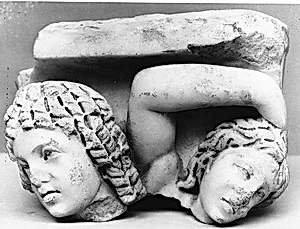
Upper right corner of a marble sarcophagus: head of a Black African and a maenad
Unknown Artist
1st quarter of the 3rd century CE
Medium
Marble-Phrygian
Dimensions
7 x 9 3/4 x 7 1/2in. (17.8 x 24.8 x 19.1cm) Other (depth of relief): 3 1/2in. (8.9cm)
Classification
Stone Sculpture
Culture & Period
Roman · Mid-Imperial, Severan
Department
Greek and Roman Art
Museum
Metropolitan Museum of Art, New York, NY
Credit
Fletcher Fund, 1928
Accession Number
28.57.3
Rights
Public Domain
Tags
Art Historical Context
This exquisite marble fragment, carved from fine Phrygian marble, captures the upper right corner of Roman sarcophagus from the first quarter of the 3 century CE, during the Mid-Imperial Severan period. It features two striking heads: one of a Black African figure with distinctive features, and a maenad, a fervent follower of the god Dionysus known for her ecstatic, flowing hair and dynamic expression. Measuring just 7 x 9¾ x 7½ inches with a relief depth of 3½, this piece exemplifies the intricate stone sculpture typical of elite Roman funerary art. Sarcophagi like this were popular among the Roman elite from the 2nd century onward, often adorned with mythological scenes symbolizing the afterlife, rebirth, or divine mysteries. The Phrygian marble, sourced from quarries in ancient Asia Minor (modern Turkey), was prized for its translucency and durability, allowing sculptors to achieve lifelike depth and texture in high-relief carving. The juxtaposition of the African head—reflecting Rome's vast multicultural empire—with the maenad highlights themes of exoticism and Dionysian revelry, common in Severan-era works. Acquired through the Fletcher Fund in 1928, this fragment now graces the Metropolitan Museum of Art's Greek and Roman Art department. It offers a window into Roman artistic prowess and cultural diversity, reminding us of an empire where gods, mortals, and far-flung peoples intertwined in stone.