
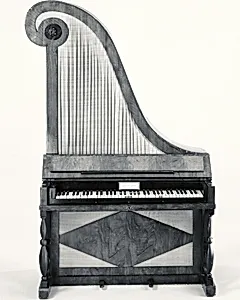
Upright (Giraffe) Piano
Medium
Wood, various materials
Dimensions
Case L. (perpendicular to keyboard): 55.3 cm (21-7/8 in.; W. parallel to keyboard): 115.8 cm (45-5/8 in.);H.: 199.5 cm (78-5/8 in.)
Classification
Chordophone-Zither-struck-piano
Culture
Austrian
Department
Musical Instruments
Museum
Metropolitan Museum of Art, New York, NY
Credit
Gift of Murtogh Guinness, 1979
Accession Number
1980.218
Rights
Public Domain
Art Historical Context
Step into the elegant world of early 19th-century music with Johann Jacob Könnicke's *Upright (Giraffe Piano* from 1810, a striking Austrian instrument now housed in the Metropolitan Museum of Art's Department of Musical Instruments. Thisophone, classified as a zither-str piano, stands an impressive 199.5 cm tall, with a slender case measuring 55.3 cm deep and 115.8 cm wide—its dramatically slanted, elongated form earning it the whimsical "giraffe" nickname. Crafted from wood and various materials, it exemplifies the exquisite cabinetry of Viennese instrument makers, blending functionality with sculptural beauty. Könnicke, a skilled piano builder active in Vienna, contributed to the piano's evolution during a golden age of musical innovation. Around 1800–1820, giraffe pianos emerged as space-saving alternatives to bulky horizontal grands, ideal for urban homes amid the rising popularity of domestic music-making fueled by composers like Beethoven and Schubert. Their upright action allowed strings to run vertically, producing a bright, resonant tone suited to intimate settings. This rare survivor, gifted by Murtogh Guinness in 1979, highlights Austrian craftsmanship's fusion of acoustics and aesthetics. Visitors can appreciate how such instruments democratized music, turning parlors into private concert halls and paving the way for modern upright pianos.