
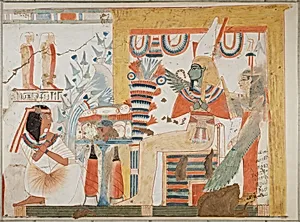
Userhat Kneeling Before Osiris and the Goddess of the West, Tomb of Userhat
A.D. 1909–1910; original ca. 1294–1279 B.C.
Medium
Tempera on paper
Dimensions
Facsimile: 67 × 91 cm (26 3/8 × 35 13/16 in.), Scale 1:1, Framed: 71.1 × 96.2 cm (28 × 37 7/8 in.)
Classification
Facsimile, Userhat (TT 51), Osiris, goddess of West
Period
Twentieth Century; original New Kingdom, Ramesside
Department
Egyptian Art
Museum
Metropolitan Museum of Art, New York, NY
Credit
Rogers Fund, 1930
Accession Number
30.4.32
Rights
Public Domain
Tags
Art Historical Context
In the tomb of Userhat, a-ranking official from Egypt's New Kingdom (Dyn 19, ca. 1294–1279 B.C.), this vivid scene captures Userhat kneeling in reverence before Osiris, the god of the afterlife, and the Goddess of the—a protective deity associated with the necropolis and eternal life. Such funerary images were essential in ancient Egyptian belief, ensuring the deceased's safe passage to the underworld through ritual adoration and offerings. Rendered in the classic Ramesside style, the original wall painting exemplifies the era's mastery of hieroglyphic integration, vibrant pigments, and idealized figures, blending art with sacred function to invoke divine favor. This stunning 1:1 scale facsimile, created by pioneering Egyptologist Norman de Garis Davies in A.D. 1909–1910, preserves the tomb's splendor using tempera on paper (67 × 91 cm). Davies, working for the Metropolitan Museum of Art's Egyptian Expedition, meticulously traced and photographed scenes from Theban tombs before they faded or were lost, making ancient masterpieces accessible today. Acquired through the Rogers Fund in 1930, it highlights early 20th-century efforts to safeguard cultural heritage. For visitors, this artwork bridges millennia, revealing how Egyptians like Userhat sought immortality through devotion to Osiris and funerary goddesses—timeless symbols of hope amid mortality. A true treasure of the Met's Egyptian Art collection!
About the Artist
Norman de Garis Davies · 1865–1941
Norman de Garis Davies (1865–1941) was a British Egyptologist and archaeological artist whose meticulous copies of ancient Egyptian tomb paintings constitute one of the most important records of pharaonic art ever made. Born in Ashton-under-Lyne, Lancashire, he originally trained for the ministry before being drawn into Egyptology through his involvement with the Egypt Exploration Fund in the 1890...