
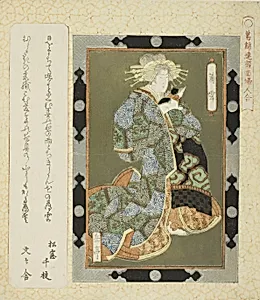
Usugumo, from the series "Framed Pictures of Women for the Katsushika Circle (Katsushikaren gakumen fujin awase)"
c. 1822
Medium
Color woodblock print; shikishiban, surimono
Dimensions
21.5 × 19.1 cm (8 7/16 × 7 1/2 in.)
Classification
woodblock print
Department
Arts of Asia
Museum
Art Institute of Chicago
Accession Number
34378
Rights
Public Domain
Art Historical Context
Behold the delicate beauty of *Usugumo* (Thin Clouds), a color woodblock print by Yashima Gakutei, created around 1822. Part of the series *Framed Pictures of Women for the Katsushika (Katsushikaren gakumen fujin awase)*, this intimate shikishiban-format work—measuring just 21.5 × 19.1 cm—captures refined elegance of bijin-ga, or pictures of beautiful women, a hallmark of Japan's ukiyo-e tradition. Gakutei, an Osaka-based artist active in the early 19th century, crafted this for a poetry-loving circle, blending visual artistry with literary homage. As a surimono, or privately commissioned print, *Usugumo* exemplifies elite Edo-period printing techniques. Produced in limited editions for New Year's greetings or poetry albums, these squares often featured embossing, mica dusting, and vibrant colors from multiple woodblocks, achieving a luxurious tactility unmatched by mass-market ukiyo-e. Gakutei's precise lines and subtle shading evoke a woman's poised grace amid hazy skies, symbolizing ephemerality in Japanese aesthetics. Housed in the Art Institute of Chicago's Arts of Asia collection, this print highlights surimono's cultural role: fostering artistic patronage among intellectuals. It offers a window into Japan's vibrant print culture, where beauty, poetry, and craftsmanship intertwined during a time of social refinement before modernization.
About the Artist
Yashima Gakutei · 1786–1868
Yashima Gakutei (c. 1786–1868), born in Osaka as the illegitimate son of a Tokugawa shogunate samurai named Hirata, adopted the name from his mother's subsequent marriage into the Yashima clan. Little is documented about his early years beyond these familial ties, but he pursued artistic training under the esteemed ukiyo-e masters Totoya Hokkei and Katsushika Hokusai, absorbing their precision in ...