
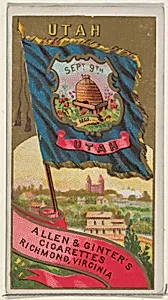
Utah, from Flags of the States and Territories (N11) for Allen & Ginter Cigarettes Brands
1888
Medium
Commercial color lithograph
Dimensions
Sheet: 2 3/4 x 1 1/2 in. (7 x 3.8 cm)
Classification
Prints|Ephemera
Department
Drawings and Prints
Museum
Metropolitan Museum of Art, New York, NY
Credit
The Jefferson R. Burdick Collection, Gift of Jefferson R. Burdick
Accession Number
63.350.201.11.85
Rights
Public Domain
Tags
Art Historical Context
This petite chromolithograph, *Utah, from Flags of the States and TerritoriesN11)*, issued by the pioneering tobacco firm Allen & Ginter in1888, captures the Flag of the Utah Territory in vivid color. Measuring just 2¾ x 1½ inches, it belongs to a popular series of collectible cards tucked into cigarette packages, blending commerce with civic pride. At a time when Utah was still a territory—statehood wouldn't come until 1896—these cards educated Americans on their expanding nation's symbols, fostering patriotism amid westward expansion. Produced via commercial color lithography, a breakthrough technique of the era, the print showcases Allen & Ginter's mastery of vibrant hues and precise detailing on a tiny scale. Chromolithography allowed for affordable, mass-produced imagery that mimicked fine art, making heraldry accessible to everyday collectors. Classified as ephemera in the Metropolitan Museum of Art's Drawings and Prints department, it reflects the Gilded Age's fusion of advertising and Americana. Today, preserved in The Jefferson R. Burdick Collection, this card highlights how everyday objects became cultural artifacts, preserving fleeting glimpses of 19th-century identity and innovation. A delightful window into tobacco-era ephemera!
About the Artist
Allen & Ginter
Allen & Ginter, the pioneering American tobacco firm based in Richmond, Virginia, emerged around 1880 from the partnership of John F. Allen and Lewis Ginter, evolving from Allen's earlier John F. Allen & Company. Allen retired in 1882, succeeded by John Pope, yet the brand endured under Ginter's leadership, employing over 1,100 workers—mostly women—for hand-rolled cigarettes by 1886. Ginter, a Dut...