
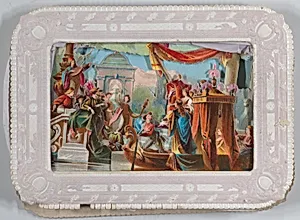
Valentine - Mechanical - scene of barge, troubadours, Temple of Hymen
ca. 1875
Medium
Heavy card-stock, die-cut scraps, chromolithography, white ribbon,lavender paper
Dimensions
Width: 3 11/16 in. (9.3 cm) Length: 5 1/8 in. (13 cm)
Classification
Ephemera|Prints
Department
Drawings and Prints
Museum
Metropolitan Museum of Art, New York, NY
Credit
Gift of Mrs. Richard Riddell, 1981
Accession Number
1981.1136.870
Rights
Public Domain
Art Historical Context
This charming mechanical valentine, created anonymously in Germany around 1875, exemplifies the elaborate paper crafts popular during the Victorian era. Measuring just over five inches long, it was crafted from heavy cardstock using chromolithography—a revolutionary printing technique that produced vivid colors through successive lithographic stones. Die-cut scraps, a white ribbon, and lavender paper were assembled to create a movable scene, allowing the recipient to interact with the artwork by pulling the ribbon to animate the figures. The composition depicts a festive barge carrying troubadours, gliding toward the Temple of Hymen, the mythological deity associated with marriage. This romantic narrative reflects 19th-century courtship customs, where such tokens expressed affection and aspirations for union. The mechanical elements add whimsy and surprise, transforming a simple card into a miniature theatrical experience. As an example of ephemera preserved in museum collections like the Metropolitan Museum of Art, this valentine highlights how mass-produced yet hand-assembled prints democratized art and sentiment during the Industrial Age. Its survival offers insight into the cultural rituals of love and celebration in the late 1800s.