
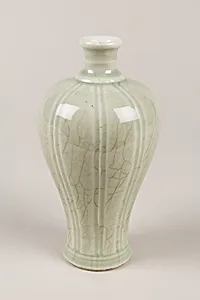
Vase
Unknown Artist
18th century
Medium
Porcelain with celadon glaze
Dimensions
H. 6 in. (15.2 cm)
Classification
Ceramics
Culture & Period
China · Qing dynasty (1644–1911)
Department
Asian Art
Museum
Metropolitan Museum of Art, New York, NY
Credit
Purchase by subscription, 1879
Accession Number
79.2.63
Rights
Public Domain
Art Historical Context
This delicate porcelain vase, hailing from China's Qing dynasty (1644–1911) in the 18th, exemplifies the era's mastery of ceramics. Standing just 6 inches (15.2 cm) tall, it features a luminous celadon glaze—a signature technique that produces a subtle, jade-like green hue. Celadon, revered since ancient times, reached new heights of refinement during the Qing period, when imperial kilns at Jingdezhen produced wares for both palace use and export, blending functionality with aesthetic elegance. The vase's unknown artist reflects the collaborative genius of Qing workshops, where potters, painters, and glazers perfected translucent porcelain bodies fired at high temperatures for durability and clarity. Celadon glazes, achieved through precise iron oxide formulas and reduction firing, symbolized purity and harmony in Chinese culture, evoking the prized jade of Confucian scholars and emperors. Acquired by subscription in 1879, this gem graces the Metropolitan Museum of Art's Asian Art department, offering visitors a tangible link to Qing opulence. Its modest scale suggests it may have adorned a scholar's desk or altar, inviting quiet contemplation amid the dynasty's artistic splendor.