
Vase
Unknown Artist
1830–70
Medium
Parian porcelain
Dimensions
4 1/8 x 1 1/2 in. (10.5 x 3.8 cm)
Classification
Vase
Culture
American
Department
The American Wing
Museum
Metropolitan Museum of Art, New York, NY
Credit
Gift of Dr. Charles W. Green, 1947
Accession Number
47.90.120
Rights
Public Domain
Tags
Art Historical Context
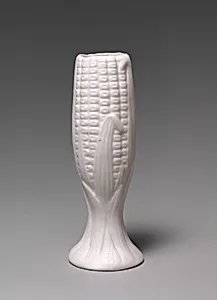
This delicate Parian porcelain vase, in America between 1830 and1870, exemplifies the mid-19th-century with neoclassical elegance in everyday decorative arts. Standing just over 4 inches tall, its petite form (4 1/8 x 1 1/2 in.) made it ideal for mantelpieces or tabletops in Victorian homes. Parian ware, an unglazed, matte-white porcelain developed in the 1840s, mimicked the translucent glow of Parian marble from the Greek islands, allowing artisans to create refined, sculpture-like objects without the heft of stone. American potteries, inspired by English and Continental examples, perfected this medium for vases, figurines, and jewelry, blending industrial innovation with artistic aspiration. The vase's corn motif—evident in its stylized ears and husks—celebrates a quintessential American symbol of abundance and harvest, reflecting the era's agrarian pride amid westward expansion and the Industrial Revolution. Such motifs underscored national identity, transforming humble corn into emblems of prosperity on fine china. Donated to the Metropolitan Museum of Art's American Wing in 1947 by Dr. Charles W. Green, this anonymous masterpiece invites us to appreciate how ordinary materials elevated domestic life into art.