
Vase
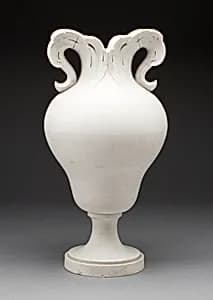
Medium
Unglazed soft-paste porcelain (biscuit)
Dimensions
H.: 33.7 cm (13 1/2 in.)
Classification
vase
Department
Applied Arts of Europe
Museum
Art Institute of Chicago
Accession Number
135732
Rights
Public Domain
Art Historical Context
This elegant vase from the Manufacture nationale deèvres, dating to around 1755, exemplifies the pinnacle of French porcelain artistry during the lavish Rococo era. Established as the royal factory in 1753 (previously Vincennes), Sèvres catered to the court of Louis XV, producing objects that blended technical innovation with refined aesthetics. Standing at 33.7 cm tall, this piece hails from the Art Institute of Chicago's Department of Applied Arts of Europe where it showcases the factory's mastery of soft-paste porcelain—a fragile, creamy material fired at lower temperatures than true hard-paste, allowing for delicate modeling. The standout feature is its unglazed biscuit finish, a matte, sculptural surface that highlights the porcelain's pure white tone and tactile allure. Unlike glazed wares, biscuit porcelain emphasized form over color, often used for figurative vases or neoclassical-inspired designs emerging in the mid-18th century. Sèvres pioneered this technique commercially, making unglazed pieces highly prized collectibles that rivaled marble sculptures in sophistication. Visitors will appreciate how this vase captures the era's pursuit of elegance and innovation, bridging decorative arts with fine sculpture—a testament to France's cultural dominance in the applied arts.
About the Artist
Manufacture nationale de Sèvres · 1763–1800
The Manufacture nationale de Sèvres, a premier French porcelain factory, flourished from 1763 to 1800 as the royal powerhouse of European ceramics, producing opulent soft- and hard-paste porcelain under the patronage of Louis XV and XVI. Originally founded in Vincennes in 1740 to rival Meissen and Chantilly, it relocated to Sèvres in 1756 and was fully acquired by the Crown in 1759, becoming the M...