
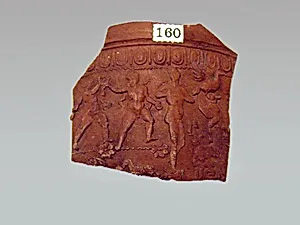
Vase fragment
Unknown Artist
Medium
Terracotta
Dimensions
3 1/16 × 3 5/16 × 1/4 in. (7.7 × 8.4 × 0.6 cm)
Classification
Vases
Culture
Roman, Gaul
Department
Greek and Roman Art
Museum
Metropolitan Museum of Art, New York, NY
Credit
Gift of J. Pierpont Morgan, 1917
Accession Number
17.194.2032
Rights
Public Domain
Tags
Art Historical Context
This delicate terracotta vase fragment hails from Roman Gaul, a encompassing much of modern-day France and surrounding regions during the Roman Empire's height (roughly 1st–4th century CE). Crafted from fired clay, a staple medium for everyday and decorative pottery, it measures just over three inches across—small enough to fit in the palm of your hand. Its survival as a mere shard speaks to the fragility of ancient artifacts, yet it offers a tantalizing glimpse into provincial Roman life and artistry. The fragment's tag of "Male Nudes" hints at classical influences, where idealized nude male figures—echoing Greek sculptures like those of athletes or gods—adorned vases in relief or painted scenes. In Gaul, such motifs blended Roman imperial tastes with local Celtic traditions, showcasing cultural fusion in workshops that produced both utilitarian and ornamental wares. Terracotta's earthy warmth and durability made it ideal for these expressive decorations, often mass-produced yet finely detailed. Generously gifted to the Metropolitan Museum of Art by J. Pierpont Morgan in 1917, this piece resides in the Greek and Roman Art department. Though anonymous and undated, it embodies the everyday artistry of Rome's far-flung frontiers, inviting us to ponder the hands that shaped it millennia ago.