
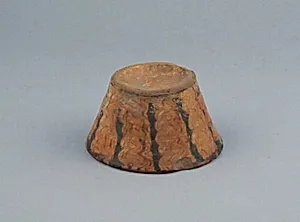
Vase fragment
Unknown Artist
Medium
Terracotta
Dimensions
H. 1 1/4 in. (3.1 cm) diameter 2 3/16 in. (5.6 cm)
Classification
Vases
Culture
East Greek/Sardis, Lydian
Department
Greek and Roman Art
Museum
Metropolitan Museum of Art, New York, NY
Credit
Gift of The American Society for the Excavation of Sardis, 1926
Accession Number
26.199.150
Rights
Public Domain
Art Historical Context
This delicate terracotta vase fragment, just 1¼ inches high and 2⅛ inches in diameter, offers a tantalizing glimpse into the ancient world of East Greek and Lydian craftsmanship.oused in the Metropolitan Museum of Art's Greek and Roman Art Department it hails from Sardis—the opulent capital of the Lydian kingdom in western Anatolia (modern-day Turkey). Acquired as a gift from the American Society for theation of Sardis in1926, it survives from archaeological digs that uncovered the splendor of this wealthy civilization, famed for innovations like coined money around the 7th–6th centuries BCE. Terracotta, a fired clay medium ubiquitous in the ancient Mediterranean, was ideal for everyday vessels due to its durability and affordability. East Greek potters, working in Ionian regions near Lydia, often blended local traditions with Greek techniques, such as wheel-throwing and simple incised or painted decorations—though this fragment's precise motifs are not detailed. Its small scale suggests it may have been part of a miniature vase or lid, used for oils, perfumes, or rituals in Lydian households. As a cultural artifact, this piece highlights the vibrant trade and artistic exchange between Greek islands, Anatolia, and the Lydian elite, bridging Eastern and Western influences long before Alexander the Great. Though modest, it embodies the enduring legacy of Sardis, a crossroads of empires destroyed by Persian conquest in 546 BCE.