
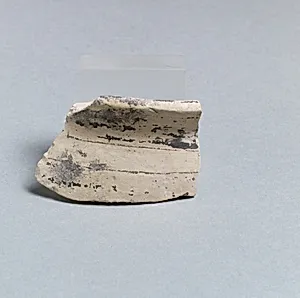
Vase fragment
Unknown Artist
ca. 3000–2000 BCE
Medium
Terracotta
Dimensions
Other: 1 5/8in. (4.2cm)
Classification
Vases
Culture & Period
Aegean · Early Helladic
Department
Greek and Roman Art
Museum
Metropolitan Museum of Art, New York, NY
Credit
Anonymous Gift, 1930
Accession Number
30.119.92
Rights
Public Domain
Art Historical Context
This delicate terracotta vase fragment hails from the Early Helladic (ca. 3000–2000 BCE), a era in Aegean prehistory on the Greek mainland. Part of the Early Bronze Age this time saw the rise of settled communities, early metallurgy, and distinctive pottery traditions that bridged Neolithic simplicity with more complex Minoan and Mycenaean to come. As a modest survivor from this distant world, it offers a tangible glimpse into the daily lives of ancient Aegean peoples, likely used for storing food, liquids, or ritual purposes. Crafted from terracotta—fired clay that was abundant and versatile—the fragment exemplifies early hand-built or slowly wheel-turned techniques common in the region. At just 1 5/8 inches (4.2 cm) tall, it speaks to the practical scale of household wares, emphasizing functionality over ornamentation in a society experimenting with form and firing methods. Its preservation highlights the durability of terracotta, which has endured millennia to reach us via an anonymous gift to the Metropolitan Museum of Art in 1930. Housed in the Met's Greek and Roman Art Department, this unassuming piece underscores the Aegean roots of later classical glory, reminding visitors how humble fragments illuminate humanity's ancient ingenuity.