
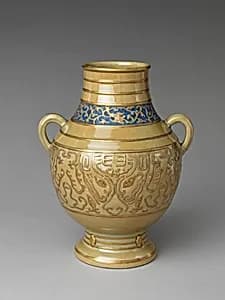
Vase in the form of an archaic bronze vessel
Unknown Artist
mid-18th century
Medium
Porcelain with relief ornament under light brown glaze, and gilt (Jingdezhen ware)
Dimensions
H. 11 1/8 in. (28.3 cm); W. (at handles): 7 3/4 in. (19.7 cm); Diam. of rim: 3 3/4 in. (9.5 cm); Diam. of foot: 4 3/4 in. (12.1 cm)
Classification
Ceramics
Culture & Period
China · Qing dynasty (1644–1911), Qianlong period (1736–95)
Department
Asian Art
Museum
Metropolitan Museum of Art, New York, NY
Credit
Purchase by subscription, 1879
Accession Number
79.2.799
Rights
Public Domain
Tags
Art Historical Context
This exquisite porcelain vase from China's Jingdezhen kilns, crafted in the mid-18th during the Qianlong period (1736–95) of the Qing dynasty,fully mimics the form of an archaic bronze ritual vessel. Standing just over 11 inches tall with sturdy handles and a flared foot, it reflects the era's fascination with ancient bronzes, which emperors like Qianlong revered as symbols of cultural prestige and imperial power. Porcelain artisans at Jingdezhen—China's premier ceramic hub—revived these archaic shapes to evoke the Zhou dynasty (c. 1046–256 BCE), blending reverence for the past with technical innovation. The vase's light brown glaze, applied over intricate relief ornaments and accented with gilt, simulates the patina of aged bronze, creating a luxurious yet historically evocative surface. The relief work likely features motifs like prominent eyes, common in ancient taotie masks on ritual vessels, adding a mystical, watchful quality. This technique showcases Jingdezhen's unmatched porcelain prowess, where fine clay and precise firing produced translucent bodies ideal for such imitative effects. Acquired by the Metropolitan Museum of Art in 1879 through public subscription, this piece highlights global appreciation for Qing ceramics. It invites visitors to ponder how 18th-century makers bridged antiquity and innovation, transforming everyday luxury into timeless art.