
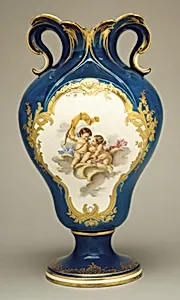
Vase (vase à oreilles) (one of a pair)
Medium
Soft-paste porcelain
Dimensions
Height: 12 1/8 in. (30.8 cm)
Classification
Ceramics-Porcelain
Culture
French, Sèvres
Department
European Sculpture and Decorative Arts
Museum
Metropolitan Museum of Art, New York, NY
Credit
Gift of Samuel H. Kress Foundation, 1958
Accession Number
58.75.114
Rights
Public Domain
Tags
Art Historical Context
This exquisite *Vase (vase à oreilles)*, one of a pair from 1758, exemplifies the pinnacle of French porcelain at the renowned Sèvres Manufactory.ed in soft-paste porcelain—a, early formula prized for its creamy translucency and ability to capture intricate modeling—this 12⅛-inch (30.8 cm) vessel modeled by the innovative sculptor Jean-Claude Dupless and gilded by Antoine Cat. The "vase with ears" design features elegant handles, evoking the playful abundance of the Rococo style under Louis XV. Adorned with frolicsome putti—chubby, winged cherubs symbolizing love and joy—the vase bursts with gilded motifs that highlight Sèvres' mastery of polychrome decoration. Soft-paste allowed for the fine detailing that made Sèvres porcelain a favorite of the royal court, including Madame de Pompadour, who championed the manufactory as a symbol of French luxury rivaling Saxony's Meissen wares. A gift to the Metropolitan Museum of Art from the Samuel H. Kress Foundation in 1958, this piece resides in the European Sculpture and Decorative Arts department, offering visitors a tangible glimpse into 18th-century opulence and technical virtuosity.
About the Artist
Sèvres Manufactory|Jean-Claude Duplessis|Antoine Caton · 1740–present
The Sèvres Manufactory, one of Europe's premier porcelain producers, was established in 1740 as the Manufacture de Vincennes under the patronage of Queen Marie Leszczyńska, who sought to rival Meissen and Chantilly porcelains with French soft-paste innovations. Initially a private venture, it relocated to Sèvres in 1756 in a purpose-built facility designed by architect Laurent Lindet near Madame d...