
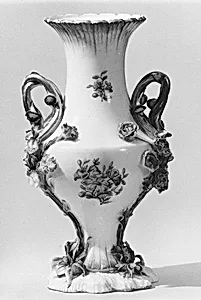
Vase (vase Duplessis) (one of a group of three)
Medium
Soft-paste porcelain
Dimensions
Height: 7 1/16 in. (17.9 cm)
Classification
Ceramics-Porcelain
Culture
French, Vincennes
Department
European Sculpture and Decorative Arts
Museum
Metropolitan Museum of Art, New York, NY
Credit
Gift of Mrs. Morris Hawkes, 1924
Accession Number
24.214.5
Rights
Public Domain
Tags
Art Historical Context
This delicate Vase Duplessis, created around 1752 by the Vincennes Manufactory collaboration with sculptor Jean-Claudeplessis, stands as a gem of French rococo porcelain artistry. Measuring just over 7 inches, it belongs to a rare group of three vases, crafted from soft-paste porcelain French innovation that allowed for the translucent, finely modeled forms prized by 18th-century aristocracy. Adorned with floral motifs its elegant curves and scrolling details capture the playful, nature-inspired exuberance of the rococo style. Vincennes, established in the 1740s under royal patronage near Paris, marked France's bold entry into porcelain production, rivaling Saxony's Meissen works. Soft-paste porcelain, fired at lower temperatures, enabled intricate gilding and painting techniques that brought vibrant flowers and organic shapes to life, symbolizing luxury and refinement for Versailles elites. Duplessis, a master modeler, lent his genius to these vases, blending sculpture with ceramics in designs that influenced generations. Today, housed in The Metropolitan Museum of Art's European Sculpture and Decorative Arts collection—a 1924 gift from Mrs. Morris Hawkes—this vase invites us to marvel at the technical wizardry and cultural prestige of pre-Revolutionary France, where porcelain was both art and status symbol.