
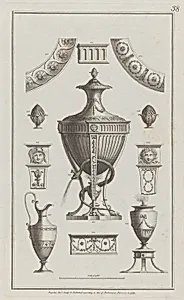
Vases and Ornament Designs, nos. 200-208, plate 38 from "Designs for Various Ornaments"
February 29, 1791
Medium
Etching
Dimensions
Plate: 17 5/8 × 10 11/16 in. (44.7 × 27.2 cm) Sheet: 19 3/4 in. × 14 in. (50.2 × 35.5 cm)
Classification
Prints|Ornament & Architecture
Department
Drawings and Prints
Museum
Metropolitan Museum of Art, New York, NY
Credit
Bequest of Herbert Mitchell, 2008
Accession Number
2018.839.22
Rights
Public Domain
Art Historical Context
Step into the elegant world of 18th-century decorative arts with *Vases and Ornament, nos. 200-208, plate 38* from Michelangelo Pergolesi's *Designs for Various Ornaments Created on February 29, 1—a rare leap day etching—this print captures the Italian artist's mastery in London, where he flourished as an engraver catering to Britain's neoclassical revival. Pergolesi drew inspiration from ancient Roman grotesques and motifs, producing pattern books that guided craftsmen in furniture, wallpaper, and architecture. Etched with precise lines on a generous plate (17 5/8 × 10 11/16 in.), this sheet showcases a symphony of vases adorned with scrolling acanthus leaves, mythical figures, and intricate arabesques—hallmarks of the ornate "grotesque" style. The medium of etching allowed for fine detail reproduction, making these designs accessible for widespread use in Regency-era interiors, blending antiquity with contemporary luxury. Housed in the Metropolitan Museum of Art's Drawings and Prints department through the 2008 bequest of Herbert Mitchell, this plate exemplifies how prints democratized high design, influencing everything from silverware to grand estates. A delightful glimpse into the era's obsession with classical elegance!
About the Artist
Michelangelo Pergolesi · 1760–1801
Michelangelo Pergolesi (1760–1801) was an Italian decorative artist, draughtsman, engraver, and designer whose career bridged Rome and London, profoundly influencing neoclassical interiors during the late 18th century. Little is known of his early life or formal training, with biographical details sparsely documented. Likely inspired by classical antiquity and the era's archaeological fervor, incl...