
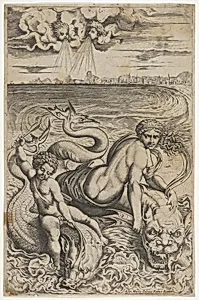
Venus and Cupid riding two sea monsters, Cupid raises an arrow in his right hand, two heads representing wind in the clouds above
Medium
Engraving
Dimensions
Sheet (Trimmed): 10 5/8 × 6 15/16 in. (27 × 17.7 cm)
Classification
Prints
Department
Drawings and Prints
Museum
Metropolitan Museum of Art, New York, NY
Credit
Bequest of Phyllis Massar, 2011
Accession Number
2012.136.277
Rights
Public Domain
Tags
Art Historical Context
Behold *Venus and Cupid riding two sea monsters*, a engraving from around 1515–27, now housed in the Metropolitan Museum of Art's Drawings and Prints department.ed by Marco Dente, this print reproduces designs attributed to the Renaissance master Raphael (Raffa Sanzio) and Giovanni Marco Paluzzi The dynamic scene bursts with mythological energy: Venus and her son Cupid astride fantastical sea beasts, Cupid brandishing an arrow triumphantly in his right hand, while ethereal wind heads swirl in the clouds above. At 10 5/8 × 6 15/16 inches, its trimmed sheet invites close inspection of the intricate details. This work exemplifies the High Renaissance fascination with classical mythology, drawing from ancient tales of love, desire, and the sea's wild forces. Raphael's fluid compositions, known for their grace and harmony, were ideally suited for engraving—a revolutionary intaglio technique that allowed precise, durable reproductions on metal plates. Engravers like Dente popularized Raphael's inventions among collectors across Europe, bridging elite workshops and broader audiences. Such prints democratized art, fostering a Renaissance cult of beauty and humanism. Fun fact: Sea monsters here evoke Neptune's domain, blending eroticism with whimsy—perfect for Renaissance patrons who adored Venus as love's divine emblem. A bequest from Phyllis Massar in 2011 preserves this gem, reminding us how prints captured eternity's playful myths.
About the Artist
Marco Dente|Raphael (Raffaello Sanzio or Santi)|Giovanni Marco Paluzzi · 1515–1527
Marco Dente (died 1527), also known as Marco da Ravenna, was among the most accomplished printmakers working in Rome during the High Renaissance, a period that witnessed an extraordinary flowering of engraving as both a reproductive and an independent artistic medium. Little is known of his early training, but by the second decade of the sixteenth century he had established himself in the orbit of...