
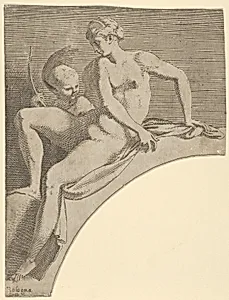
Venus, from "Twelve Muses and Goddesses"
Medium
Etching
Dimensions
Sheet (trimmed): 8 7/8 × 6 11/16 in. (22.6 × 17 cm)
Classification
Prints
Department
Drawings and Prints
Museum
Metropolitan Museum of Art, New York, NY
Credit
The Elisha Whittelsey Collection, The Elisha Whittelsey Fund, 1949
Accession Number
49.97.552
Rights
Public Domain
Tags
Art Historical Context
Behold *Venus, from "Twelve Muses andes"*, a captivating etching created between 1540 and 1556 by Italian Mannerist artist Francesco Primatic and French engraver Léonent. Part of a renowned series celebrating classical deities, this print depicts the goddess of love in an elegant, elongated pose typical of Mannerism—a stylish evolution from the High Renaissance, marked by graceful distortion and refined sophistication. Primaticcio, a key figure in France's School of Fontainebleau under King Francis I, designed these compositions to blend Italian elegance with French innovation, making mythological figures accessible to a wider audience. Etching, the medium here, was a revolutionary printmaking technique in the 16th century. Davent incised fine lines into a metal plate with acid, allowing for intricate details and tonal subtlety that captured Primaticcio's fluid lines and dynamic forms. Measuring just 8 7/8 × 6 11/16 inches, this trimmed sheet exemplifies how prints democratized art, circulating elite designs from the royal court to collectors across Europe. Housed in the Metropolitan Museum of Art's Drawings and Prints department, this work highlights the cultural revival of antiquity during the Renaissance, where Venus symbolized beauty and desire. It's a window into the opulent world of Fontainebleau, where art served both decoration and intellectual delight.
About the Artist
Francesco Primaticcio|Léon Davent · 1504–1570
Primaticcio was the most influential Italian artist in France in the 16th century. Together with Rosso Fiorentino they created a style of mixing stucco decoration with mannerist paintings that became known as the Fontainebleau school. Italian painter, architect and sculptor. Comment on works: Religious; Allegory; History.