
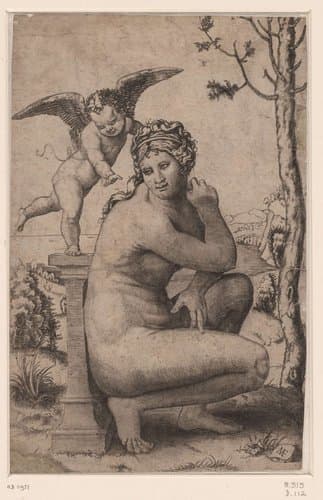
Venus hurkend bij zuil waarop Amor staat
1510 - 1527
Medium
engraving
Dimensions
218; 141
Rights
Public Domain
About this artwork
height 218 mm x width 141 mm
Art Historical Context
**Venus Hurkend bij Zuil Waaraan Amor Staat** *antonio Raimondi,. 1510–1527, Engraving, 218 × 141 mm* Step into the enchanting world of High Renaissance mythology with Marcantonio Raimondi's exquisite engraving *Venus Hurkend bij Zuil Wa Amor Staat* (Venus Crouching by the Pillar on Which Amor Stands). This intimate print captures the goddess of love, Venus, in a graceful crouch beside a slender column topped by her son, Amor (Cupid), symbolizing tender maternal affection and divine beauty. Rendered in precise lines on a modest 218 × 141 mm plate, it invites viewers to ponder the playful intimacy of classical gods amid Renaissance humanism. Raimondi, a masterful Italian engraver active in early 16th-century Rome (c. 1480–1534), revolutionized printmaking by translating paintings into durable, reproducible images. Often collaborating with Raphael, he elevated engraving from mere craft to high art, using intricate burin techniques for tonal depth and texture rivaling oil paintings. This period piece, dated between 1510 and 1527, reflects the era's fascination with antiquity, making elite art accessible to collectors across Europe. Its cultural significance lies in democratizing Renaissance ideals—love, proportion, and grace—through affordable prints. Raimondi's legacy endures as a bridge between painting and mass imagery, influencing artists like Dürer and shaping the print market. Gaze closely; each line whispers stories of eternal devotion.
About the Artist
Marcantonio Raimondi · 1475–1534
Marcantonio Raimondi (c. 1480–1534), born near Bologna, Italy, emerged as one of the Renaissance's premier engravers, revolutionizing printmaking through his mastery of reproductive techniques. He trained in the workshop of the goldsmith, painter, and niellist Francesco Francia, whose influence is evident in his early engravings, such as the goldsmith-like shading in *Pyramus and Thisbe* (1505), h...